
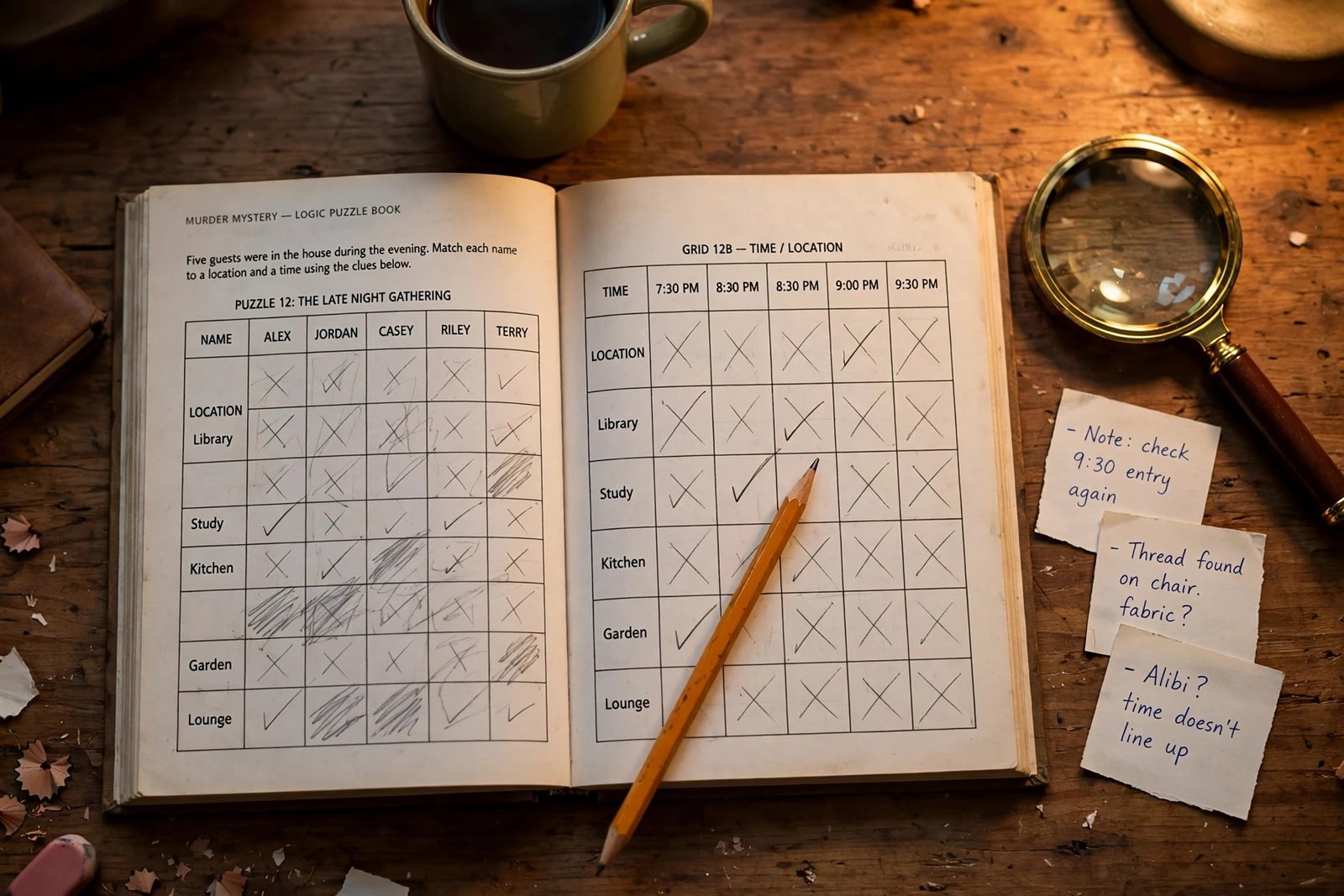
Every mystery solver knows the moment. You have been staring at the same case for twenty minutes, your pencil hovering over the page, and the answer key at the back of the book starts to feel very tempting. Before you give in and read the solution, there is a better move: use a hint. Done right, a hint does not spoil the case. It unsticks you, teaches you something, and leaves the final discovery still yours.
Learning how to use hints in murder mystery puzzle books is really about learning restraint. A good hint system works like a ladder. You climb one rung at a time, and you stop climbing the moment you can move forward again. Most solvers who say hints ruined a puzzle did not use a bad hint. They used too much of a good one, or they skipped straight to the strongest hint when the gentlest nudge would have done the job. This guide will show you a spoiler-free hint ladder you can use with any puzzle book, plus tactics for logic grids, word searches, and deduction puzzles. If you are looking for books with well-designed hints built in, you can browse Zira Vale’s murder mystery puzzle books on Amazon and pick a format that suits your solving style.
What a Hint Is — and What It Is Not
A hint is a small piece of direction. It points your attention, not your answer. A good hint might tell you to re-read a particular clue, to check one row of your grid, or to reconsider the order of events. It should never hand you the name of the culprit, the method, or the motive on a plate. If a hint does that, it is not a hint at all. It is a spoiler wearing a hint’s clothes.
That distinction matters because the pleasure of a mystery puzzle comes from the solve itself. The moment when scattered clues suddenly line up is the whole point. A spoiler skips that moment entirely. A well-used hint protects it. Think of it this way: a spoiler tells you the destination, while a hint reminds you to look at the road sign you drove past. You still do the driving. And using a hint is not cheating. Puzzle books include hints on purpose, because their authors know that getting stuck is part of solving. A solver who takes one gentle nudge and then finishes the case alone has still solved the case.
The Spoiler-Free Hint Ladder
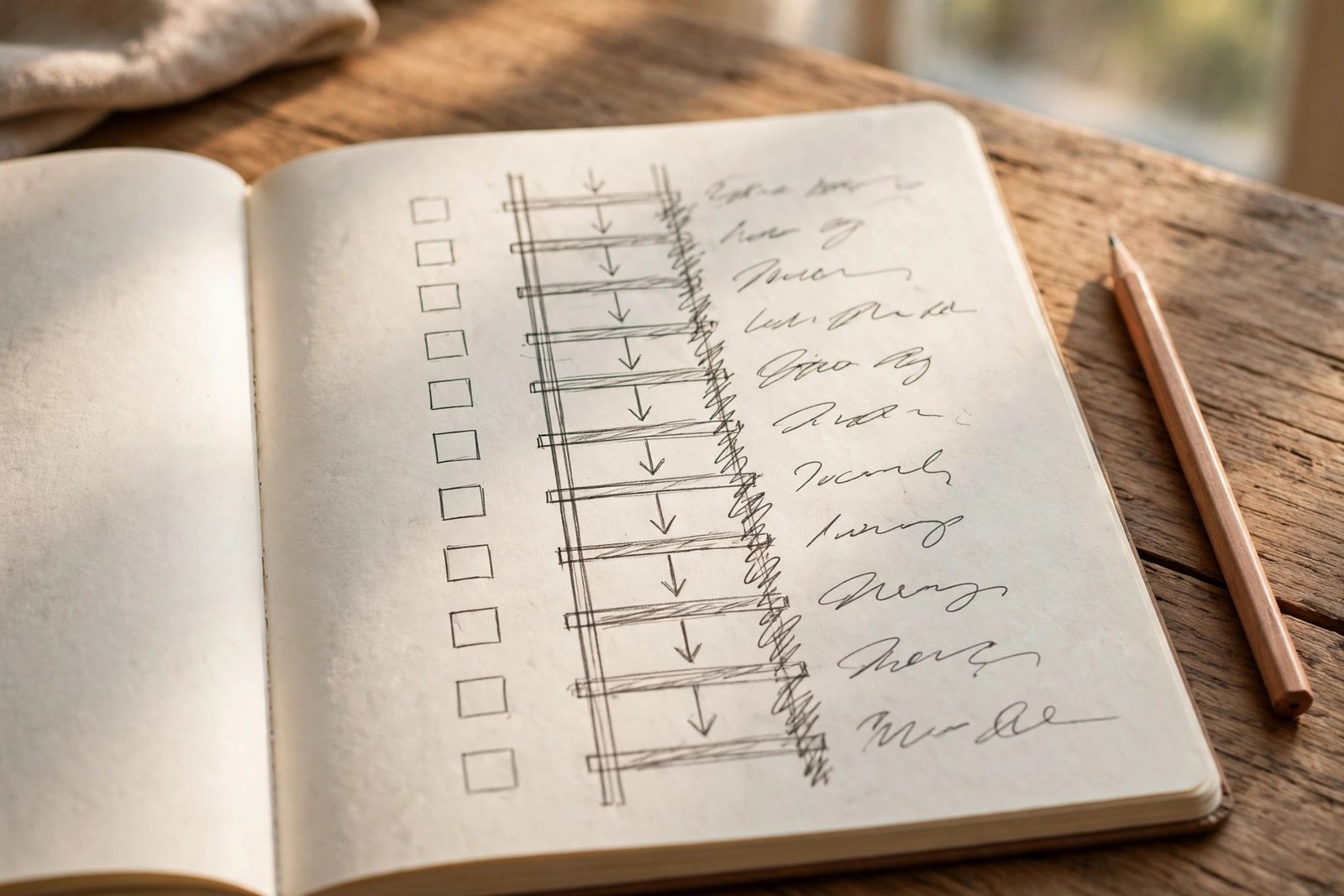
The core method in this guide is the hint ladder. It has five rungs, from the gentlest nudge to the strongest help you should take before reading a full solution. The rule is simple: always start at the bottom rung, take only one rung at a time, and go back to solving after each rung. Never climb two rungs at once, and never peek at a higher rung “just to see” what it says. Curiosity is exactly how spoilers happen.
Rung one is the re-read nudge. Put your pencil down and read the case again slowly, from the beginning. Fresh eyes catch details tired eyes miss. Rung two is the focus nudge. Instead of asking what the answer is, ask where you are stuck: a timeline, a location, or a single suspect? Narrow the problem to one question, and look only at the clues that touch it. Naming the gap is often half the solution.
Rung three is the method nudge. If you have been working in your head, draw a grid. If your grid is a mess, start a clean one. If you have been staring at names, switch to the timeline. Sometimes the puzzle is not hard; your approach is just pointed in the wrong direction. Rung four is the clue nudge: the first rung where you look at a hint from the book. Take only the smallest hint available, cover the rest immediately, and return to solving. Do not read the second hint until you have genuinely tried to use the first one.
Rung five is the strong nudge, the last step before a full solution. A strong hint may point directly at a key deduction. Even here, stop reading the moment you understand the direction, and finish the rest of the case yourself. If you climb all five rungs and still cannot move, take a break instead of opening the answer key, and come back tomorrow with fresh eyes.
Before You Take Any Hint: The Five-Minute Check
Before you climb the ladder at all, run a quick five-minute check. This habit alone will cut your hint use in half, because many stuck moments are simple errors, not hard puzzles. Check your grid for a wrongly marked box, re-read the clue in full rather than from memory, check whether you skipped a clue, ask whether you locked onto one suspect too early, and review the timeline. If the check does not unstick you, take a hint with a clear conscience. You did the work first, and the hint is now a tool, not a shortcut.
Using Hints in Logic Grid Puzzles
Logic grid puzzles have their own hint logic, because the grid itself is a map of what you know. When you are stuck on a grid puzzle, the most useful hint is almost always about where to look, not what to fill in. A good first hint might say something like “check the row for the afternoon times” or “one clue about locations has not been used yet.” That kind of direction narrows your search without giving anything away.
If your book provides hints for a grid case, take them in the same ladder order: a general direction first, a specific row or clue second, and a direct deduction only as a last resort. And when you do take a grid hint, mark the result in pencil, not pen. If you are still learning how grids work, this guide to logic grid puzzles for beginners explains the symbols and basic moves in plain language.
Using Hints in Word Search Mysteries
Word search mysteries work differently, and so do their hints. In this format, finding hidden words is part of the puzzle, and a hint that simply tells you where a word hides can feel like a bigger spoiler than it is. The trick is to ask for a different kind of hint first. Instead of asking where a word is, ask how many letters it has, what direction it runs, or which section of the grid to search. Each of those narrows the hunt without ending it.
Only after those steps should you take a book hint, and again, take the smallest one. A hint that says “look in the upper corner” still leaves you searching, which is exactly right. A hint that circles the word for you ends the puzzle. If you want to understand how this format blends word hunting with deduction, this explanation of how murder mystery word searches work walks through the twist step by step.
Using Hints in Deduction and Whodunit Puzzles
Deduction puzzles, where you read a scene and reason out the culprit, need the gentlest hints of all, because a single pointed hint can collapse the whole mystery. Here the best first hint is a question, not an answer. Ask yourself: what does each suspect claim, and which claim can be checked against a hard fact? Claims are opinions. Facts are times, places, objects, and things that were seen. The gap between a claim and a fact is where most whodunit solutions hide.
When a deduction puzzle offers staged hints, read only the first stage, then close the hint section and work for at least ten minutes before reading more. Deduction needs thinking time. A hint read too quickly, before your brain has wrestled with the problem, feels like a spoiler because you have not yet built the context to use it as a nudge. If you are new to this style, the step-by-step method in how to solve your first murder mystery puzzle pairs well with the ladder in this guide.
How Books With Two Hints Per Case Are Designed to Help You
Some puzzle books give you exactly two hints per case, and that design is worth understanding, because it shapes how you should use them. Two hints usually mean a gentle nudge first and a stronger nudge second, with no third option before the solution. That structure is deliberate. It forces you to make each hint count, and it protects you from the slow slide of reading hint after hint until the case solves itself. With a two-hint book, treat the first hint as your rung four and the second hint as your rung five. Never read both at once. Read the first hint, work for a solid stretch, and only reach for the second hint if you are still genuinely stuck after real effort.
Hint Habits That Spoil Cases (and What to Do Instead)
A few common habits quietly turn hints into spoilers, and they are worth naming so you can avoid them. The first is peeking at the solution “just to check one thing.” Checking one thing almost always shows you three more, and once you have seen the ending, you cannot unsee it. If you must check something, check a hint, not the solution. Hints are built to be partial. Solutions are not.
The third habit is asking someone else to solve the stuck part for you. A friend who says “oh, it is obvious, just look at the timeline” has given you a fine nudge. A friend who explains the whole deduction has spoiled the case just as surely as the answer key would. If you solve with a partner, agree in advance that hints are questions and directions only, never conclusions. That one rule keeps group solving fun instead of frustrating.

When to Walk Away Instead of Taking Another Hint
Sometimes the best hint is no hint at all, but a break. If you have climbed the ladder, taken a real hint, worked hard, and still feel lost, your brain may simply be tired. A tired solver misreads clues and marks grids wrong. A short break, a walk, or a night of sleep often solves the case faster than another hint would.
Try this rule: one hint per sitting, and no more than two sittings on the same case in one day. If the case still resists, put the book down. When you return, start with a full re-read, not with the hint section. Many solvers find the answer jumps out at them on the second day. Regular puzzle solving is also good for your mind, as this look at the benefits of puzzle books for adult brain health explains. Walking away is not quitting. It is a strategy experienced solvers use constantly.
Choosing Puzzle Books With Hint Systems You Will Love
Zira Vale’s puzzle books cover the main formats, so you can match the book to the hint style you prefer. If you love scene-based deduction, The Scene Keeps Secrets offers 80 cases built around scene plans, logic grids, and hints. For a pure grid challenge, The Guilty Square offers 80 room-grid cases with 2 hints per case, a perfect fit for the two-hint method in this guide. Prefer variety? When Clues Accuse serves up 90 puzzles across 8 deduction formats, also with 2 hints per case. And if word puzzles are your comfort zone, One Word from Murder offers 100 word searches across 3 difficulty levels, so you can start easy and build up.

Your Spoiler-Free Hint Routine, All in One Place
Here is the complete routine, ready to use tonight. First, run the five-minute check. Second, climb the hint ladder one rung at a time, going back to solving after every rung. Third, keep a hint log so you can spot your own patterns. Fourth, if hints and effort still do not work, take a break and return fresh.
That is the whole system, and it works for logic grids, word searches, and deduction puzzles alike. The secret is structure: small nudges, in order, with solving time between them.
Ready to practice? Browse all of Zira Vale’s murder mystery puzzle books on Amazon and choose your next case: the scene-based deduction of The Scene Keeps Secrets, the room-grid challenges of The Guilty Square, the eight-format variety of When Clues Accuse, or the word-search mysteries of One Word from Murder. Open a case, keep this ladder beside you, and enjoy the best kind of evening: the one where a single gentle hint is all it takes, and you solve the mystery yourself.


0 Comments