
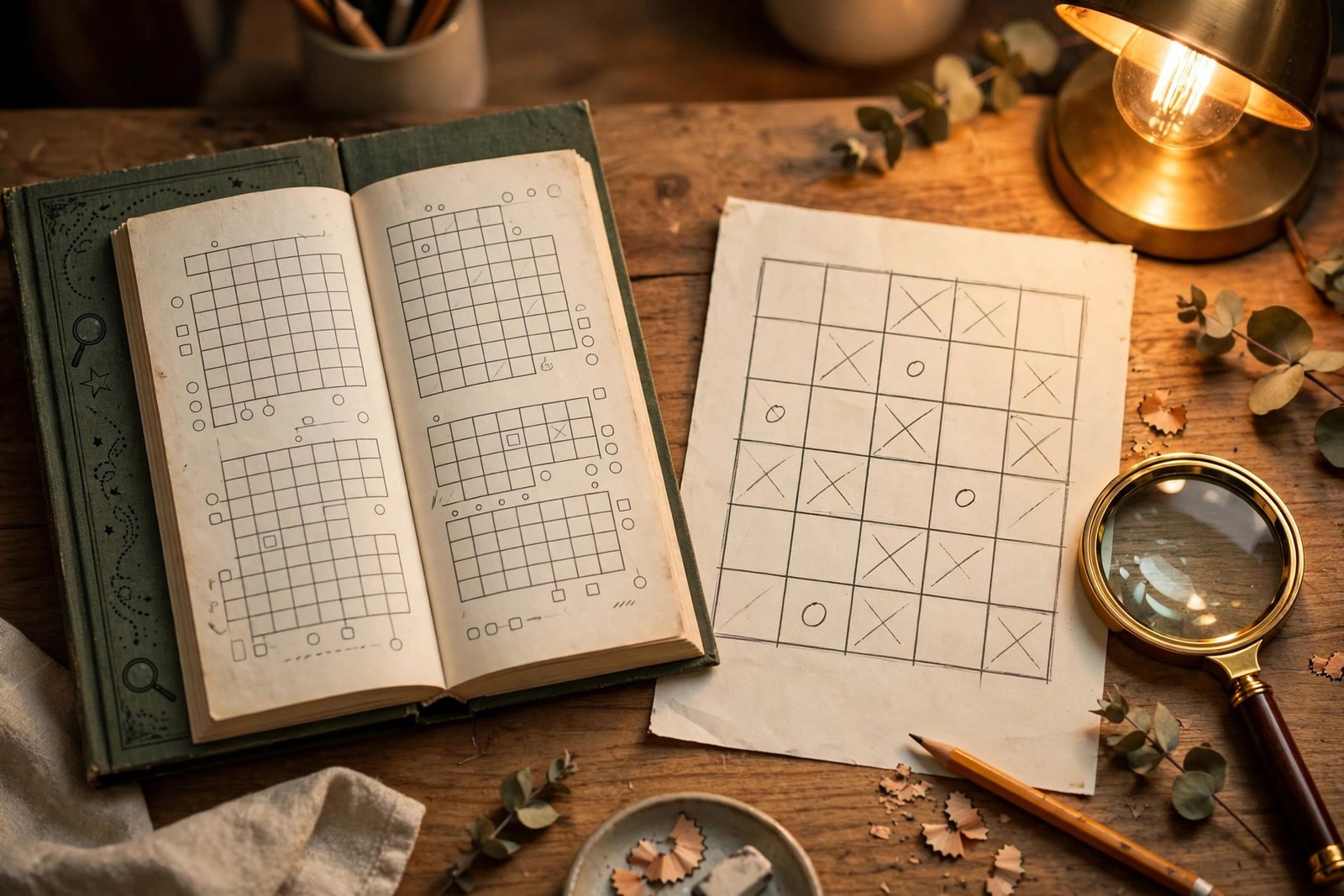
Every detective has a moment where the story stops making sense. Three suspects, three rooms, three different stories — and only one version of events can be true. A logic grid puzzle hands you that exact moment and says: you sort it out. Instead of turning pages to find out whodunit, you become the investigator, working through a set of clues until only one solution still fits.
If logic grid puzzles have ever looked complicated, this guide is for you. The grid is really just a tidy way of organizing what you know — and once you understand it, even a tangled murder mystery case breaks down into a series of small, satisfying deductions.
What Is a Logic Grid Puzzle?
A logic grid puzzle is a deduction puzzle built around matching items across a few categories. You might have a group of suspects, the rooms they were in, and the objects they were holding. Every item in one category pairs with exactly one item in each other category, and your job is to work out the correct pairings using nothing but the clues provided.
There is no guessing and no trivia knowledge involved. Everything you need is in the clues, and as the grid fills in, the correct solution is the only arrangement left standing. Murder mystery versions add a layer of story: the categories become suspects, scenes, and alibis, and each puzzle becomes a small fictional case to crack — the pleasure of a whodunit, except the reveal is one you earned yourself.
The Anatomy of a Logic Grid
Before solving your first case, it helps to know what you are looking at. A typical puzzle has four parts:
- The setup. A short introduction to the situation — the people involved and what you need to figure out.
- The categories. Usually three or four groups, such as suspects, locations, and items. Each group has the same number of options.
- The grid. A chart where the categories cross. Every box in the grid represents one possible pairing, like one suspect in one room.
- The clues. A numbered list of statements. Some tell you a definite match, some tell you what is not true, and some connect two facts you have to combine.
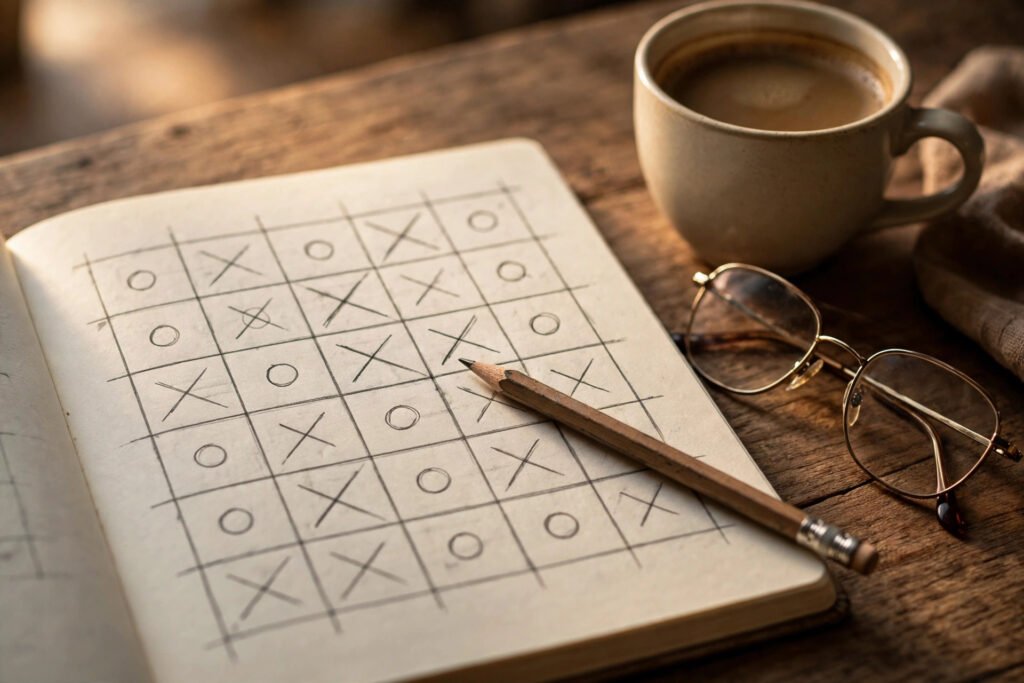
Your two working symbols are simple. An O marks a pairing you have confirmed is true, and an X marks one you have eliminated. That is the whole toolkit.
How to Solve a Logic Grid Puzzle, Step by Step
Step 1: Read every clue before marking anything
Resist the urge to start with the first clue and work down. Skim the whole list first — some clues only make sense once you have seen the others, and a quick read-through stops you from missing an easy connection later.
Step 2: Mark the definite clues first
Start with statements that give you a direct fact. If a clue says a suspect was definitely in a particular room, place an O in that box. Then place an X in every other box in that row and column, because that suspect cannot be anywhere else, and nobody else can be in that room. One confirmed fact clears a surprising amount of the grid.
Step 3: Mark the negative clues
Negative clues tell you what did not happen, and beginners often underrate them. If a clue says a suspect was not in the kitchen, that box gets an X. Every X narrows the field, and a row with only one open box left is a solved pairing waiting to be noticed.
Step 4: Combine clues to unlock new facts
This is where the real detective work happens. A clue might tell you that whoever carried the notebook was in the library, without naming anyone. On its own, that fills in nothing — but if another clue names the notebook carrier, the two click together and you earn a new O. Return to earlier clues whenever you learn something new.
Step 5: Transfer every new fact across the grid
A fact learned in one section of the grid applies to the others. If you confirm a suspect's room, and you already know something about that room, carry the information over. Many stuck moments are simply a fact marked in one place and forgotten in another.
Step 6: Check your solution against every clue
When the grid is complete, test your answer against every clue one final time. A correct solution satisfies them all. If one clue does not fit, it usually points you back toward the mistake.
A Tiny Worked Example
Here is a small example invented just for this guide, so you can watch the process in miniature. Three suspects — Maya, Leo, and Sam — were each in a different room of a house: the library, the kitchen, or the study. One of them carried a notebook. The clues are:
- Maya was not in the kitchen.
- Whoever carried the notebook was in the library.
- Leo carried the notebook.
- Sam was not in the study.
Start with the definite fact: clue 3 says Leo carried the notebook, so mark that pairing with an O. Now combine clues: clue 2 says the notebook carrier was in the library, so Leo was in the library — another O, and the library column is now closed to everyone else. Clue 1 says Maya was not in the kitchen, and the library is taken, so Maya must have been in the study. That leaves the kitchen for Sam — and clue 4 confirms Sam was not in the study, which fits. Case closed, and notice that you never guessed once. Every step was forced by the clues.
That is exactly the rhythm of a full-size case, just with more categories and a richer story.
Where to Try Your First Real Case
Once the method clicks, a full book of cases is the natural next step. Our guide to The Scene Keeps Secrets walks through a collection built entirely around this style of deduction. The Scene Keeps Secrets: 80 Murder Mystery Logic Puzzles for Adults by Zira Vale contains 80 fictional cases that combine scene plans and logic grids, with optional hints available when a case pushes back. That structure suits beginners well: you can wrestle with a stubborn case as long as you like, then take a hint instead of peeking at the answer.
For another casebook in the same spirit, our guide to The Guilty Square is the natural next read.

5 Beginner Tips That Make Puzzles Easier
- Work in pencil. Everyone makes a wrong deduction sometimes. Pencil turns a mistake into a two-second fix instead of a ruined page.
- Mark as you go, not from memory. Write down every X and O the moment a clue gives it to you. Holding deductions in your head is the fastest route to confusion.
- Re-read clues after every breakthrough. A new fact can suddenly activate a clue that meant nothing five minutes earlier.
- Look for rows that are almost full. A category with only one open box left is a free answer. Scan for those before wrestling with harder clues.
- Slow down on the wording. Words like "not," "neither," and "exactly one" carry the whole meaning of a clue. Reading carefully is a solving skill.
Common Mistakes to Avoid
- Guessing to keep momentum. A guess poisons everything built on top of it. If a fact is not forced by the clues, leave the box empty.
- Forgetting to cross out the rest of a row. Every confirmed O eliminates the other options in its row and column. Skip that step and you lose half the value of the fact.
- Treating "not" clues as unimportant. Negative information is real information. Some cases are solved mostly by elimination.
- Assuming categories pair up in order. The first suspect listed is not automatically linked to the first room listed. Only clues create connections.
- Skipping the final check. Testing your finished grid against every clue takes a minute and catches the one careless mark.
Frequently Asked Questions
Are logic grid puzzles hard for beginners?
They look harder than they are. The grid is just a record-keeping tool, and the method never changes: mark what is definite, mark what is impossible, and combine clues. Start with smaller puzzles, and the difficulty grows naturally from there.
Do I need to be good at math to solve logic grid puzzles?
No. There is no arithmetic involved at all. Logic grid puzzles use reasoning, not numbers — if you can follow a clue, rule out an option, and keep track of what you know, you already have every skill the puzzle requires.
What should I do when I get completely stuck?
Scan the grid for a fact you marked in one section but never carried into another, then re-read the clues slowly, especially the negative ones. And if a book offers optional hints, use one without guilt — it nudges you past one sticking point while leaving the rest of the case yours to solve.
Ready to Open Your First Case File?
Logic grid puzzles reward patience, attention, and that wonderful moment when the last X falls into place and only one answer remains. Learn the grid, trust the clues, and never guess — the case will do the rest. If you are ready to put the method to work, you can find The Scene Keeps Secrets on Amazon and start with your first of its 80 cases. Pencil ready, detective?
More Books by Zira Vale
Zira Vale writes coloring books and puzzle books for adults who love a creative, screen-free break. You can browse and buy all of her books in one place on her Amazon author page: See all books by Zira Vale on Amazon.


0 Comments