
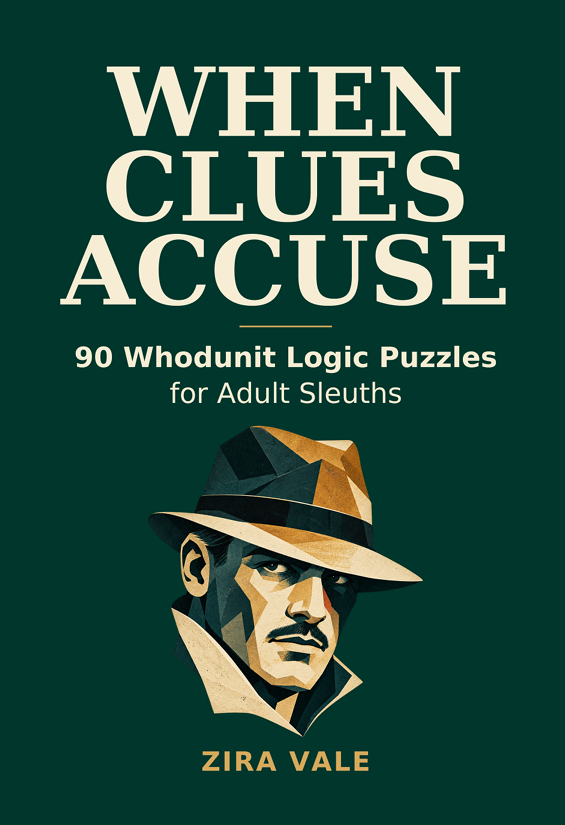
Available on Amazon — View the Book →
A good whodunit does more than ask who looks suspicious. It gives you a set of facts, a handful of possible explanations, and a challenge: can you prove which explanation fits? When Clues Accuse: 90 Whodunit Logic Puzzles for Adult Sleuths by Zira Vale is built around that satisfying process. Instead of simply reading a mystery and waiting for the reveal, you become the investigator—organizing clues, testing possibilities, and ruling out conclusions that do not fit the evidence.
Designed for adults who enjoy detective stories, brain teasers, and structured reasoning, this puzzle collection brings together multiple kinds of deduction. Some cases ask you to connect people with objects and places. Others rely on schedules, seating arrangements, floor plans, codes, statements, or a clue that cannot be true. The setting changes from case to case, so the solving method has to change with it.
READY TO INVESTIGATE?
Put Your Deduction Skills to the Test
Meet When Clues Accuse: 90 Whodunit Logic Puzzles for Adult Sleuths by Zira Vale. Follow the evidence, work through the formats, and see whether your solution holds up.
VIEW THE BOOK ON AMAZON →

What Is When Clues Accuse?
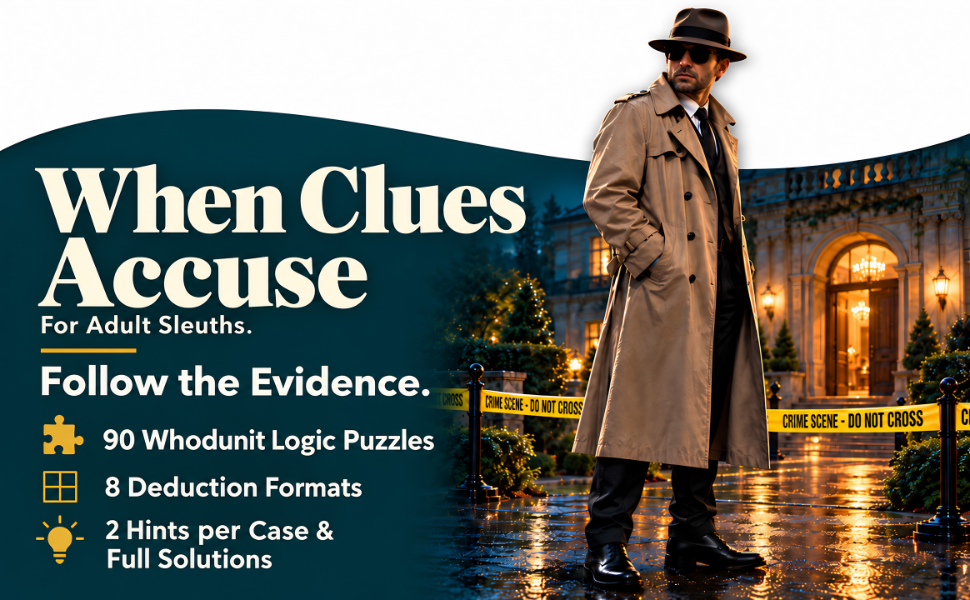
When Clues Accuse is a collection of 90 whodunit logic puzzles created for adult sleuths. Each case presents a fictional incident and a structured problem to solve. You read the case setup, study the printed plan or puzzle information, then use the evidence and numbered clues to identify the answer requested by that case.
The key idea is fair deduction. The answer should come from the information supplied—not from guessing based on a character’s job, personality, or dramatic backstory. A suspect may sound untrustworthy, a room may feel ominous, and a detail may seem important, but the reliable route to a solution is to apply the stated rules and evidence consistently.
That makes the book different from a conventional mystery novel. You are not only following a plot; you are actively building and checking a solution. You can make a tentative match, test its consequences, cross it out when it contradicts a clue, and continue until the complete arrangement works.
Eight Deduction Formats to Keep the Cases Varied
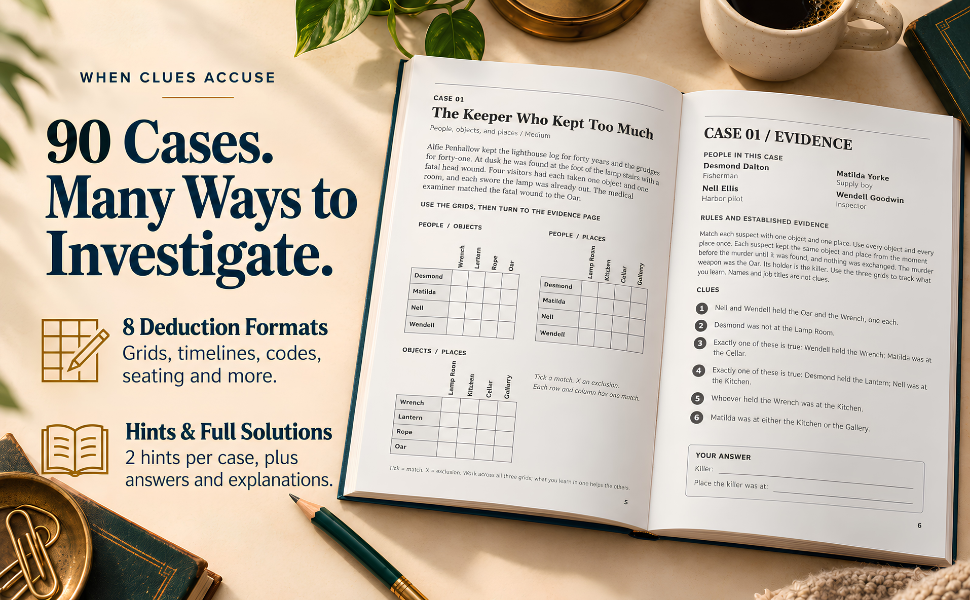
One of the collection’s defining features is variety. Rather than asking you to solve every case with the same kind of grid, the book uses eight deduction formats. That variety is useful because different evidence calls for different ways of thinking.
1. People, Objects, and Places
These puzzles ask you to connect categories—for example, which person was associated with which object and location. A match in one grid can create a restriction in another. If one person cannot have a particular object, that exclusion may help determine where the object went and which remaining pairing is possible. The challenge is to keep all categories consistent at once.
2. Liar-and-Truth Deduction
In statement-based cases, characters make claims and the rules explain how many statements are true or false. The wording matters: a statement that combines two details may only count as true if the complete statement is correct. Rather than deciding who seems believable, you test each possible arrangement against the truth conditions.
3. Finding the False Clue
Some cases center on a set of clues where one clue is false. You must identify which clue conflicts with the others and then use the remaining information to solve the case. This format rewards careful comparison: a clue can look plausible by itself and still be the one that breaks the full set of constraints.
4. Schedules and Timelines
Timeline puzzles turn order and time into evidence. Appointments may happen in sequence, checks may establish a narrow window, or a particular event may fit only one time slot. Read the time rules closely. “Immediately before,” “one slot apart,” and “strictly between” are not interchangeable. The printed intervals and conditions determine which possibilities remain.
5. Floor-Plan and Spatial Deduction
Spatial cases ask you to interpret labeled locations, levels, paths, doors, or barriers. A route may be one-way, an opening may be blocked, or a relationship may depend on a position rather than a straight-line distance. Use the plan’s labels and the rules written for that case instead of measuring an illustration or assuming that an unlabeled line creates a connection.
6. Seating Deduction
Seating puzzles use a fixed arrangement—often around a table—where neighbors, clockwise order, or a specified seat determine the answer. A person who is “next to” someone occupies an adjacent position under the case’s rules. Circular seating adds a useful twist because the final seat can be adjacent to the first. Marking confirmed neighbors and exclusions can quickly narrow the options.
7. Code Deduction
Code puzzles use attempts and feedback to determine a number sequence. You may need to distinguish a digit in the correct position from one that belongs in the code but sits in the wrong position. Track what each attempt proves and what it rules out. Avoid treating a digit as confirmed unless the feedback supports that conclusion.
8. Other Structured Relationship and Evidence Challenges
Across the collection, cases combine named categories, recorded evidence, restrictions, and deduction aids in different ways. The practical skill remains the same: translate each clue into a condition, keep track of confirmed facts, and check the proposed answer against every rule. The change in format keeps the collection from feeling like one repeated exercise.
Together, these approaches make the book a fit for readers who enjoy logic puzzles for adults, whodunit brain teasers, detective puzzle books, and murder-mystery challenges that ask for more than a quick guess.

How to Solve a Case Without Guessing
If you are new to deduction puzzles, the best strategy is to slow down at the beginning. Read the case setup and its rules before trying to name the culprit. The story establishes the situation, but the numbered clues and any stated conditions tell you what must be true in the solution.
- List the categories. Identify the people, objects, rooms, times, seats, or other items that must be assigned.
- Record fixed facts first. If a person, location, or time is already established, mark it before exploring uncertain options.
- Translate each clue into a rule. “Either A or B,” “not in,” “immediately after,” and “exactly one” each place different limits on the answer.
- Track both matches and exclusions. A mark that confirms one pairing can eliminate other pairings in the same row or category.
- Test one possibility at a time. Follow its consequences. If it forces a contradiction, reject it and return to the last confirmed fact.
- Check the complete answer. Do not stop when one suspect looks likely. Confirm that every clue and every assignment rule is satisfied.
This method is useful beyond murder mysteries. It develops the habit of separating a claim from the evidence for it, checking assumptions, and noticing when a conclusion depends on something the facts never established.
Why the Evidence Matters More Than a Suspicious Story
Whodunit fiction often encourages readers to look for motive, opportunity, and unusual behavior. Those details can make a story engaging, but a logic puzzle has a more precise standard. The answer must fit the conditions supplied by the puzzle. A dramatic backstory is context, not a substitute for a deduction.
That distinction is part of the fun. You might initially favor one suspect, only to discover that the timeline excludes them. A location may seem possible until a blocked route rules it out. A statement may sound convincing until a second clue makes it impossible. Each new restriction changes the set of viable answers, and the solution emerges from the combined evidence.
For readers who enjoy analytical challenges, this structure creates a satisfying rhythm: observe, hypothesize, test, revise, and verify. It also makes the puzzles approachable in short sessions. You can work on one case during a break, return to a difficult arrangement later, and continue from your notes.
Two Optional Hints for Each Case
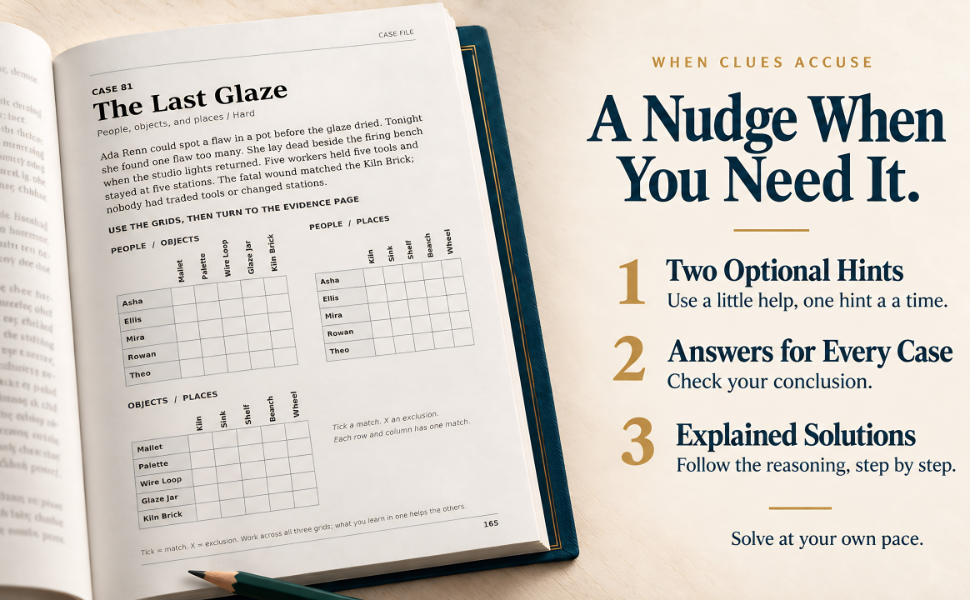
Getting stuck is part of solving. A puzzle can have several moving parts, and sometimes the hardest step is simply finding a productive place to begin. When Clues Accuse includes two optional hints per case, giving you a way to seek a nudge without immediately reading the complete explanation.
Try using the first hint as a directional prompt. It may help you focus on a relationship or rule that deserves attention. Then make another attempt on your own before turning to the second hint. This staged approach keeps the work yours while offering support when you need it.
Hints are especially useful when you have filled a grid with marks but cannot see what follows. Instead of starting over, revisit the wording of the relevant clue, compare the remaining options, and ask which confirmed fact can be carried into another category or part of the plan.

Full Solutions and Explanations Help You Learn
Each case also has a full solution with the completed assignment and an explanation of the reasoning. The goal is not only to learn the answer, but to understand why it works. When you finish a case, compare your result with the solution and check the clues one by one.
If your answer differs, avoid looking only at the final name or code. Find the first point where your deductions diverged. Perhaps you treated “either” as exclusive when the rules did not say that, missed a restriction on a route, or forgot that every listed position must be used once. Finding the first mistaken assumption is often more valuable than simply seeing the correct arrangement.
Readers who solve accurately can still benefit from the explanation. It offers a chance to compare methods and learn a more efficient route through the clues. Over time, you may start to recognize useful patterns: which restrictions should be applied first, when to test a hypothesis, and how a small exclusion can unlock a larger grid.
Small Clues Can Change the Whole Investigation
One of the most satisfying parts of a logic mystery is how a seemingly minor detail can reshape the entire case. A single time restriction may eliminate two appointments. A statement that is true only when both parts are correct may rule out an otherwise attractive arrangement. A blocked doorway can make a route impossible even when the distance appears short. These are not decorative details; they are constraints that the final answer must respect.
For that reason, avoid ranking clues by how dramatic they sound. A short, technical rule can be more decisive than a paragraph of story. Read the labels on plans, check what a symbol means, and distinguish an explicit fact from an assumption you have added yourself. If the book says that a plan is schematic and not to scale, use the printed labels and relationships—not your estimate of the drawing.
Build a Clean Deduction Record
For longer cases, it helps to keep your notes tidy. Use one symbol for a confirmed match and another for an exclusion, and avoid making a mark when you are only guessing. If you test a possibility temporarily, label it as a trial. When that trial leads to a contradiction, erase or clearly cross out the temporary chain so it does not become confused with established evidence.
When a puzzle uses several linked categories, carry information across every relevant comparison. A confirmed person-object pairing can affect the object-place grid, which in turn may restrict a person-place pairing. Leaving one grid out of date can make a solved case look inconsistent. The purpose of the notes is to make the logic visible, not to decorate the page.
In time-based cases, write the slots in order and distinguish an exact time from a position in the sequence. In seating cases, draw the circular order clearly and remember which direction counts as clockwise. In code cases, record what each attempt says about digits and positions. A consistent notation makes it easier to see patterns and reduces the chance of repeating a deduction.
Choose a Challenge That Fits Your Mood
Because the collection uses different deduction styles, you can choose a case according to the kind of thinking you feel like doing. If you enjoy visual organization, a grid or floor plan may be appealing. If you like precise sequences, try a timeline. If you enjoy eliminating combinations, a code puzzle offers a different kind of focus. Switching formats can keep a long puzzle session fresh.
You can also make the activity social without turning it into a race. Two readers can solve the same case separately, compare notes, and explain why they accepted or rejected a possibility. The most interesting discussion often comes from a step where the reasoning differs—not simply from comparing final answers. If you prefer to work alone, the hints and explanations offer a similar opportunity to review your method at your own pace.
A Practical Way to Use the Two Hints
Hints work best when you treat them as stepping stones. Before opening a hint, write down what you know, which options remain, and exactly where the reasoning has stalled. Then read the hint and ask how it connects to your existing notes. Try to make the next deduction yourself rather than jumping immediately to the final assignment.
If the first hint is not enough, spend another minute testing the suggested direction. The second hint can help you move forward, but you still get more value when you do the final linking yourself. Afterward, use the full solution to check every part of the answer. This process turns help into a learning tool and makes the next case easier to approach.
Who Will Enjoy This Adult Sleuth Puzzle Book?
- Fans of detective stories: If you like mysteries and want to participate in the investigation rather than only read about it, these cases put the evidence in your hands.
- Logic-puzzle enthusiasts: Multiple formats give you a range of structured challenges, from grids and schedules to codes and spatial relationships.
- Readers who enjoy brain teasers: Each case invites you to test alternatives, catch contradictions, and work toward a verifiable answer.
- People who prefer independent activities: The cases are designed to be solved one at a time, making it easy to fit a puzzle session into a quiet evening or weekend.
- Gift shoppers for mystery fans: A whodunit logic puzzle book can be a thoughtful option for someone who enjoys detective themes and pen-and-paper challenges.
The book is intended for adult sleuths, but you do not need specialist knowledge of crime scenes, medicine, engineering, or geography. The relevant conditions are provided in the cases themselves. The work comes from interpreting the information carefully and keeping the rules consistent.
Make a Comfortable Puzzle Routine
You do not need to race through the collection. Choose a quiet spot, keep a pencil nearby, and give yourself room to test possibilities. If a case feels difficult, take a short break and return with fresh eyes. A small note about what you know for certain can help you restart without repeating every step.
It can also help to use a consistent process: read the instructions, mark fixed facts, apply the most restrictive clues, and check the finished answer. When you use a hint, note which new deduction it suggests. When you consult the solution, identify the reasoning step you want to remember for the next puzzle.
Most importantly, treat a false start as useful information. A possibility that fails has still taught you something about the limits of the answer. Logic puzzles are not about never making a mistake; they are about noticing contradictions and correcting them systematically.
What Makes When Clues Accuse Worth Considering?
The collection combines a clear investigative theme with a broad mix of deduction styles. Its 90 whodunit logic puzzles give readers many opportunities to practice careful reasoning, while the two hints per case and full solutions provide support at different stages of the process. The eight formats help vary the challenge, so readers can move between different kinds of structured evidence rather than repeat the same grid over and over.
Whether you prefer untangling an alibi, placing people on a plan, reconstructing a timeline, testing a code, or checking a seating arrangement, the central challenge remains compelling: can you make every piece of evidence fit without forcing a conclusion?
READY TO INVESTIGATE?
Put Your Deduction Skills to the Test
Meet When Clues Accuse: 90 Whodunit Logic Puzzles for Adult Sleuths by Zira Vale. Follow the evidence, work through the formats, and see whether your solution holds up.
VIEW THE BOOK ON AMAZON →
Frequently Asked Questions
How many puzzles are in When Clues Accuse?
The book is presented as a collection of 90 whodunit logic puzzles for adult sleuths.
What kinds of deduction puzzles are included?
The collection uses eight formats, including people-object-place matching, truth and liar statements, false-clue deduction, schedules and timelines, floor plans, seating arrangements, and code puzzles, along with other structured evidence challenges.
Does the book include hints?
Yes. Each case includes two optional hints so you can ask for a small nudge before looking at the full solution.
Are solutions explained?
Yes. The book includes complete solutions and explanations, allowing you to check your answer and review the reasoning.
Do I need special knowledge to solve the cases?
No specialist knowledge is required. The information and rules needed for each puzzle are supplied in the book; careful reading and logical deduction are the key skills.
Where can I find When Clues Accuse?
You can view the Amazon product page using the link below.
View When Clues Accuse on Amazon →
When Clues Accuse: 90 Whodunit Logic Puzzles for Adult Sleuths by Zira Vale invites you to follow the evidence, challenge your first assumptions, and solve each case one deduction at a time.
Frequently Asked Questions
How many puzzles are in When Clues Accuse?
When Clues Accuse is presented as a collection of 90 whodunit logic puzzles for adult sleuths.
What types of puzzles are included?
The book uses eight deduction formats, including matching, truth and liar statements, false clues, timelines, floor plans, seating arrangements, and code deduction.
Does each case include hints?
Yes. Each case includes two optional hints, plus a complete solution and explanation.
Do I need specialist knowledge?
No. The rules and information needed for each case are supplied in the puzzle book.
Where can I buy When Clues Accuse?
Use the Amazon product link provided in the article to view the listing.


0 Comments