

A flower coloring book for adults can be much more than a way to fill empty time. It can become a small creative ritual: a quiet table, a few favorite pencils, and a botanical page that slowly changes as you choose each color.
Flower and botanical coloring has a particular advantage for adults because nature already gives you an endless color vocabulary. Petals can be soft or dramatic, leaves can stay realistic or become imaginative, and the same illustration can look completely different with a new palette.
For anyone searching for flower coloring books for adults, botanical coloring pages, or a relaxing creative hobby, the most useful place to start is with the design itself: what flowers and plants are included, how much detail the pages have, and whether the layouts leave enough room to enjoy the coloring process.

What Makes a Flower Coloring Book for Adults Enjoyable?
The best experience is not necessarily the most complicated page. A good adult coloring page gives you enough detail to stay engaged while still making the shapes comfortable to color.
Botanical designs work especially well because they naturally combine large focal flowers with smaller leaves, stems, herbs, and supporting details. That lets you change pace from one area to another instead of working on the same kind of pattern for an entire page.
Current adult coloring products also commonly emphasize floral and botanical themes, relaxation, creativity, and pages that work with colored pencils, markers, or similar supplies.
Inside Unhurried Botanicals
Unhurried Botanicals is presented as an easy plant and flower coloring book for adults and beginners. Its cover describes 40 unique botanical designs, including graceful flowers and leafy plants, succulents, herbs, and peaceful garden scenes. The book is positioned around a slower, relaxed coloring experience with easy-to-medium detail and single-sided coloring pages.
That mix is useful when you want variety. A large floral composition can become a longer coloring session, while a simpler plant or succulent page can be a quicker project when you only have a little time.

Start With a Simple Botanical Color Palette
You do not need a huge pencil set to make a botanical page look finished. Start with three to five colors and repeat them throughout the illustration.
- Soft garden: sage green, dusty pink, cream, muted yellow, and warm brown.
- Spring flowers: lavender, blush pink, fresh green, sky blue, and soft yellow.
- Classic botanical: forest green, terracotta, cream, burgundy, and golden yellow.
- Modern neutral: olive, beige, charcoal, ivory, and one stronger accent color.
- Autumn garden: rust, mustard, deep green, warm brown, and burgundy.
A limited palette also makes the final page feel more cohesive. If one flower is your focal point, repeat one of its colors in smaller leaves or decorative details elsewhere on the page.
How to Color Flowers Without Making Them Look Flat
One simple technique is to begin with a light base color and add a darker shade where petals overlap or fold toward the center. You can then soften the transition with a lighter pencil or a second related color.
Leaves can use the same principle. Instead of coloring every leaf the same green, choose a light, middle, and dark green. Place the darkest tone near overlaps and along selected edges, then leave some lighter areas untouched.
This approach creates depth without requiring advanced drawing skills. It is also a good reason to keep a few similar shades together in your pencil case while working on a botanical page.

What a Finished Flower Coloring Page Can Look Like
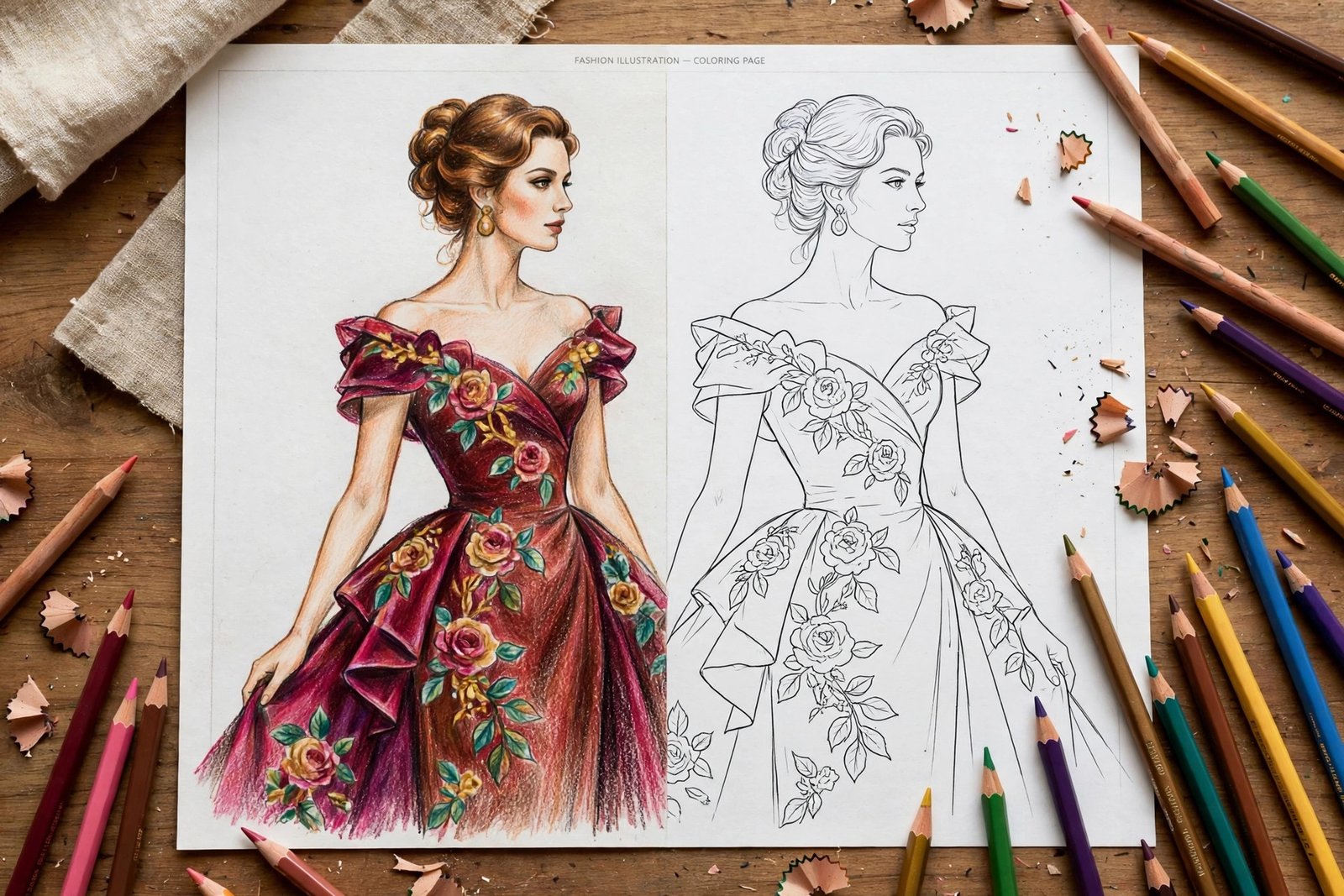
Coloring communities often share finished pages because the same line art can produce very different results. A floral page can be realistic, pastel, dramatic, vintage-inspired, or completely unexpected depending on the palette.
For comparison, the external examples below show the broader adult-coloring experience: colored pencils, an active coloring setup, and finished color choices. They are not pages from Unhurried Botanicals; they are included as visual inspiration for how a line-art page can be approached.

External inspiration: a free-to-use Pexels image showing a coloring-book and colored-pencil setup.

External inspiration: a free-to-use Pexels image showing a colorful coloring workspace.
Use Your Coloring Pages as Small Creative Projects
A finished page does not have to stay inside the book. If you are happy with a particular flower, you can photograph it, place it in a simple frame, or keep it in a folder as part of a personal collection.
You can also use the page as a color study. Try coloring the same type of flower with two different palettes and compare the mood. One version might feel fresh and spring-like, while another could look richer and more autumnal.
Flower Coloring Is Also a Good Way to Practice Color
Botanical illustrations give beginners a practical way to learn about hue, contrast, repetition, and shading. You can see immediately how a warm flower looks against cool leaves, or how a darker background changes the feeling of a light-colored bloom.
That makes adult flower coloring useful beyond the page itself. The same color observations can influence journaling, craft projects, illustration, stationery, or other creative work.

Tips for Beginners Choosing Coloring Supplies
Colored pencils are an easy starting point because you can build color gradually and control small botanical areas. Gel pens can add small highlights or decorative accents. Markers can create stronger, flatter areas of color, but always consider the paper and possible bleed-through before working on an important page.
If you are just starting, do not wait until you own every possible color. A small set with several greens, a few flower colors, a yellow, a brown, and a neutral can already create many different botanical palettes.
Why Single-Sided Pages Can Be Useful
Single-sided pages are convenient when you want to concentrate on one illustration without worrying as much about the artwork printed on the reverse side. They can also make finished pages easier to remove, display, or keep separately, depending on the book's binding and paper.
Unhurried Botanicals is presented with single-sided coloring pages, which fits naturally with this style of creative use.
A Quiet Garden, One Page at a Time
The appeal of botanical coloring is simple: you start with a page of line art and finish with something that reflects your own choices. There is no single correct color for a flower, and there is no requirement to finish an entire page in one sitting.
If you enjoy flowers, plants, garden scenes, or relaxing creative hobbies, a flower coloring book for adults can give you a practical place to experiment with color while making artwork you can actually keep.
About Unhurried Botanicals
Unhurried Botanicals is an easy plant and flower coloring book for adults and beginners, with 40 unique botanical designs covering flowers, plants, herbs, succulents, and garden scenes. The cover presents it as a quiet, relaxed coloring experience with easy-to-medium detail.
If you would like to see the complete book and purchase it, you can view Unhurried Botanicals on Amazon.
Frequently Asked Questions
What is a flower coloring book for adults?
It is a coloring book built around flowers, plants, and botanical illustrations with layouts intended to give adults a more engaging creative experience.
Is Unhurried Botanicals good for beginners?
Yes. The book is specifically presented as an easy plant and flower coloring book for adults and beginners, with easy-to-medium detail.
What are the best supplies for flower coloring pages?
Colored pencils are a versatile starting point. Markers and gel pens can also work well when the paper is suitable for them.
How do I choose colors for botanical coloring pages?
Start with a small palette of related colors. You can use realistic garden colors or create an imaginative palette with pastels, neutrals, or deeper seasonal shades.
Can finished coloring pages be displayed?
Yes. Depending on the paper and binding, favorite pages can be photographed, stored in a portfolio, or framed as personal artwork.
Frequently Asked Questions
What is a flower coloring book for adults?
It is a coloring book built around flowers, plants, and botanical illustrations with layouts intended to give adults a more engaging creative experience.
Is Unhurried Botanicals good for beginners?
Yes. The book is presented as an easy plant and flower coloring book for adults and beginners, with easy-to-medium detail.
What are the best supplies for flower coloring pages?
Colored pencils are a versatile starting point. Markers and gel pens can also work well when the paper is suitable for them.
How do I choose colors for botanical coloring pages?
Start with a small palette of related colors. You can use realistic garden colors or create an imaginative palette with pastels, neutrals, or deeper seasonal shades.
Can finished coloring pages be displayed?
Yes. Depending on the paper and binding, favorite pages can be photographed, stored in a portfolio, or framed as personal artwork.
0 Comments