
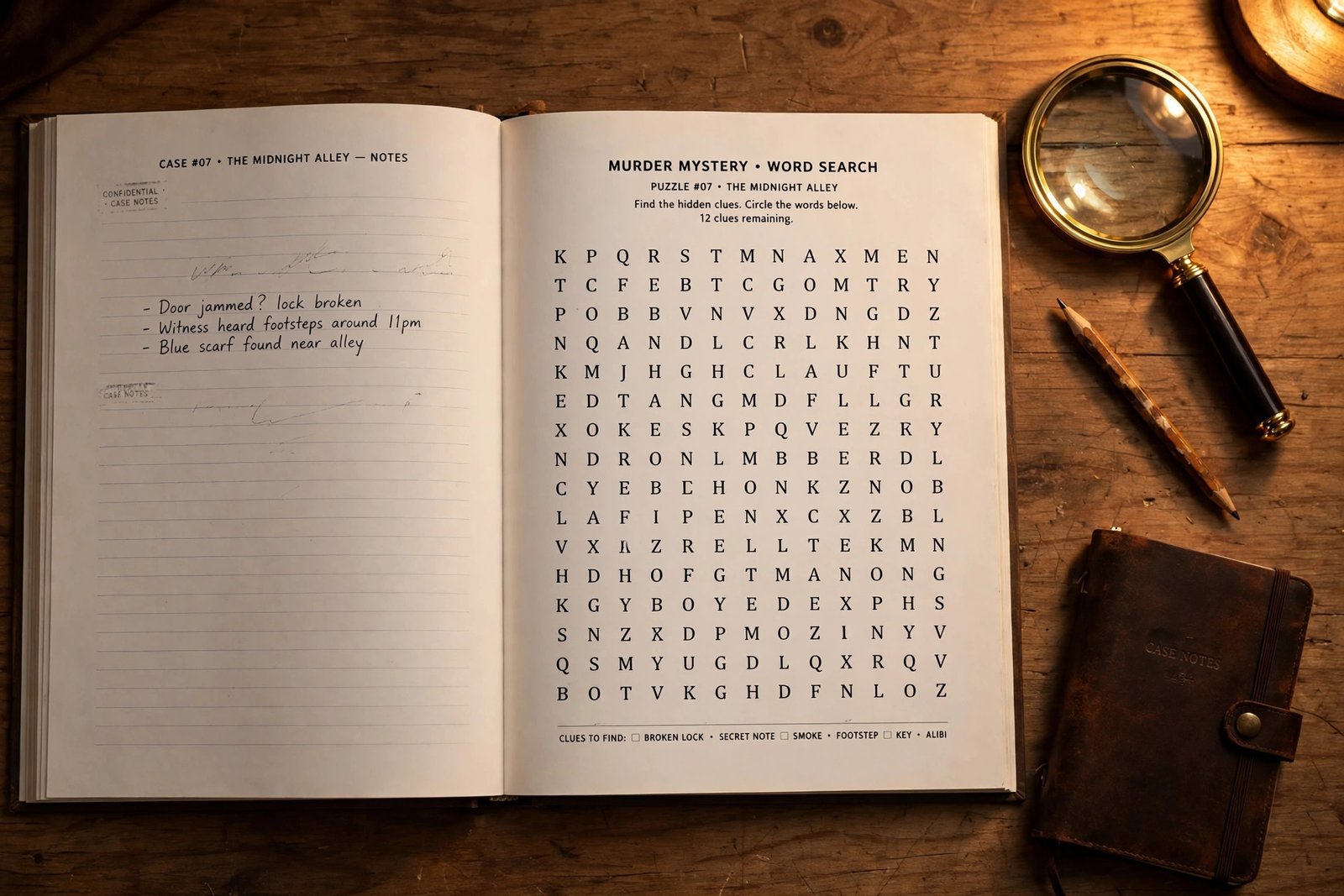
You already know how a word search works: you scan a grid of letters, find the hidden words, and circle them one by one. Now imagine that same familiar puzzle with a detective twist: every grid is a crime scene, every word list is evidence, and the words you find — and one word you cannot find — combine to crack a fictional case. That is exactly what a murder mystery word search does, and it is one of the most beginner-friendly ways to step into detective puzzles.
If you want to try the format right away, One Word from Murder: 100 Murder Mystery Word Searches for Adults by Zira Vale is built around this very idea, with 100 cases across three difficulty levels. You can also explore Zira Vale's full mystery puzzle collection on Amazon. This guide explains how the puzzles work, how they differ from the word searches you grew up with, and how to solve your first case with confidence.
What Is a Murder Mystery Word Search?
A murder mystery word search is a word search puzzle wrapped in a short fictional investigation. Each case opens with a story: something has gone wrong, a cast of suspects is introduced, and a list of evidence, locations, and case details is laid out. Your job is to search the letter grid for the words on the list, just like a classic word search. The difference is what happens next: the search itself becomes the investigation, and its result points you toward the solution of the case.
In a regular word search, finding every word is the finish line. In a murder mystery word search, the words are clues tied to suspects, evidence, and locations from the story, so each word you circle feels like a piece of the puzzle falling into place.
This format is especially welcoming for beginners. You do not need to learn grid notation or deduction rules before you start. If you can scan for a word in a letter grid, you already have the core skill, and the mystery layer adds excitement without adding complexity.
How a Murder Mystery Word Search Differs from a Regular Word Search
The most important difference is purpose. A regular word search is a scavenger hunt: the list tells you what to find, and finding it all is the whole game. A murder mystery word search turns that hunt into a case file, with words connected to the story — a piece of evidence, a location, a detail from a suspect's statement — so circling them feels like gathering evidence rather than checking boxes.
The second difference is the twist at the end. In One Word from Murder, one listed entry is not present in the grid at all. That missing entry is not a printing error — it is a clue. The case instructions tell you which report field it identifies, and the letters you did not use in the grid, read in printed order, provide the other findings. Instead of simply finishing a list, you end each case by completing a short fictional report with three findings: the offender, the location, and the evidence.
The third difference is atmosphere. Regular word searches often use loose themes — animals, foods, seasons — with no story connecting one puzzle to the next. Mystery word searches give every grid a narrative frame: a short story, a suspect list, and a case to close. When you are invested in a story, the moment the solution clicks feels like a genuine reveal rather than a completed chore.

How a Case Works, Step by Step
Every case follows a repeatable method, so once you learn it on your first case, you can use it on all 100. Here is the process used in One Word from Murder.
Step 1: Read the story and the suspect list
Start with the short story, not the grid. Read what happened, who was involved, and what the case worksheet asks you to find. The story is fictional — names and occupations are part of the puzzle setting, not claims about real people — but it orients you and helps you anticipate the kinds of words on the list.
Step 2: Search the grid in the allowed directions
Next, search the grid for the listed words. Words run in straight lines, and a few may cross or share a letter. The directions you may search depend on the difficulty level. At the easiest level, words run right and down only; as you progress, all eight directions come into play, including diagonals and backward words.
Step 3: Find the word that is missing
Here is where the detective twist kicks in. Every listed word appears exactly once in the grid — except for one. When you have searched carefully and one entry simply will not turn up, do not assume you missed it. Check it again, then trust the method: that missing entry is itself a finding, and the case instructions tell you which report field it identifies.
Step 4: Read the unused letters
Once you have circled the words you found, look at the letters that remain uncircled. Read them from left to right, beginning with the top row. The case worksheet indicates how many letters belong to each remaining answer, and those leftover letters reveal the other two findings. Some cases also use a decoder reference: if the instructions name a decoder, use the corresponding code and read rows in the reference section first.
Step 5: Complete the case report
Finally, write up your three findings: the offender, the location, and the evidence. The missing word identifies one finding, and the unused letters reveal the other two. That completed report is your solved case — the moment the puzzle stops being a search and becomes a solution.
One fair-play note for beginners: the answer must come from the grid, the case instructions, and the decoder rules when one is specified. A suspicious motive may make a character interesting, but it does not prove guilt on its own. If you follow the method, you can solve it — no guessing, no outside knowledge required. For more on fair-play deduction, see our guide to logic grid puzzles for beginners.
Difficulty Levels and How to Progress
One Word from Murder organizes its 100 cases into three levels, so you can build confidence before taking on the more demanding grids. The progression teaches you the method at a gentle pace and then stretches your skills gradually.
Easy: Cases 001–010. These use 10 × 10 grids with words running right and down only. With only two directions to check, you can focus entirely on learning the case method without the added challenge of diagonal or backward words. Start here even if you are an experienced word search solver, because the missing-word mechanic is new and deserves a few easy runs.
Medium: Cases 011–050. These step up to 12 × 12 grids using all eight directions, including diagonals and backward words. Most solvers spend the bulk of their time at this level — it is the sweet spot between relaxing and challenging.
Hard: Cases 051–100. These use 14 × 14 grids, again with all eight directions, designed to offer a more challenging search. Save these for longer puzzle sessions. You do not have to solve every case in order — you can choose any standalone case that catches your eye.
Begin with Easy to learn the method, move to Medium when you feel comfortable, and treat Hard as a reward, not a hurdle.
Solving Strategies That Actually Help
Beyond the basic method, a handful of strategies will make your searches faster and more enjoyable.
Scan in patterns, not randomly
Random scanning is slow and tiring. Instead, pick a system. At the Easy level, scan each row left to right, then each column top to bottom. At Medium and Hard, add diagonal passes, looking for the first letters of the words you still need. Working systematically means you cover the whole grid without re-checking the same patch of letters five times.
Use the themed word list as a preview
Before you start circling, read the whole word list once. In a mystery word search, the list is themed around the case, so previewing it primes your brain for the words you are about to look for. You will spot them faster when you know roughly what starting letters to expect.
Track the missing entry deliberately
When you are down to the last few uncircled words, slow down. Check each remaining word in every allowed direction before concluding it is the missing one. A common beginner mistake is declaring a word missing when it is actually hiding backward or diagonally.
Work the leftover letters carefully
The leftover-letter step rewards neatness. Circle found words completely, and double-check that you have not accidentally circled a stray letter. Then read the unused letters row by row, left to right, from the top. The worksheet tells you how many letters belong to each answer, so use those counts as a check: if your leftover letters do not split sensibly into the expected lengths, re-scan for a word you may have mis-circled. A pencil, rather than a pen, is your friend here.

Building a Screen-Free Evening Routine
One of the best uses for a murder mystery word search book is as the centerpiece of a screen-free evening wind-down. Many adults want something engaging to do after dinner that is not another hour of scrolling, and a single case fits that slot perfectly. An Easy or Medium case takes roughly 15 to 30 minutes — long enough to feel like a real activity, short enough to finish before bed.
A simple routine works well: make a cup of tea or cocoa, settle into your favorite chair, and solve one case. If you solve with a partner, read the story aloud and search together — one person scans rows while the other scans columns — and debate the missing entry before checking the report.
The routine also builds skill quietly. One case a day will carry you through the Easy section in under two weeks and into Medium with real confidence.
Which Mystery Book Should You Start With?
If murder mystery word searches are your entry point, One Word from Murder is the natural first book: 100 cases, three difficulty levels, and the gentlest learning curve of any detective puzzle format. Once you enjoy the mystery flavor, here is how the other collections by Zira Vale compare.
The Scene Keeps Secrets offers 80 murder mystery logic puzzles built around scene plans and logic grids, with hints to help when a case gets thorny. The Guilty Square gives you 80 room-grid cases — suspects mapped against rooms — with 2 hints per case, making it the most approachable pure-logic option. When Clues Accuse delivers 90 puzzles across 8 deduction formats, also with 2 hints per case, for solvers who want story-driven whodunits. Our comparison of whodunit puzzles versus logic grid puzzles and our roundup of the best murder mystery puzzle books for adults break down these styles in more detail.
The ladder is simple: word searches for relaxation, logic grids for systematic deduction, whodunits for story-driven reasoning. Start with the format that sounds fun — fun is what keeps you solving.

A Gift for the Mystery Lover in Your Life
Murder mystery word searches also make an excellent gift, and they are a safer choice than a harder puzzle book if you are not sure of the recipient's skill level. A fan of detective shows, cozy mysteries, or true crime podcasts will recognize the format instantly, and the Easy section means they can enjoy it from the very first case without prior puzzle experience. It suits birthdays, holidays, and host gifts.
Because each case is standalone, the recipient can open the book anywhere and start solving immediately, with no storyline to catch up on and no difficulty wall in the first pages. If they already love word searches, the mystery twist gives them a fresh reason to pick up a familiar format. If they love mysteries but have never tried puzzles, it is the gentlest possible on-ramp to a new hobby.
Start Your First Case Tonight
So, how do murder mystery word searches work? You read a short fictional case, search a letter grid for the words on the list, identify the one listed entry that is missing, and use the leftover letters to complete a case report naming the offender, the location, and the evidence. It is the classic word search you already know, with a detective twist that turns every finished grid into a solved mystery.
The best way to understand the format is to solve a case yourself. Get One Word from Murder on Amazon and start with Case 001: a 10 × 10 grid, words running right and down only, and a mystery waiting in the leftover letters. Or browse Zira Vale's complete mystery puzzle collection on Amazon. Either way, your first case is waiting — and the culprit is hiding in the grid.


0 Comments