
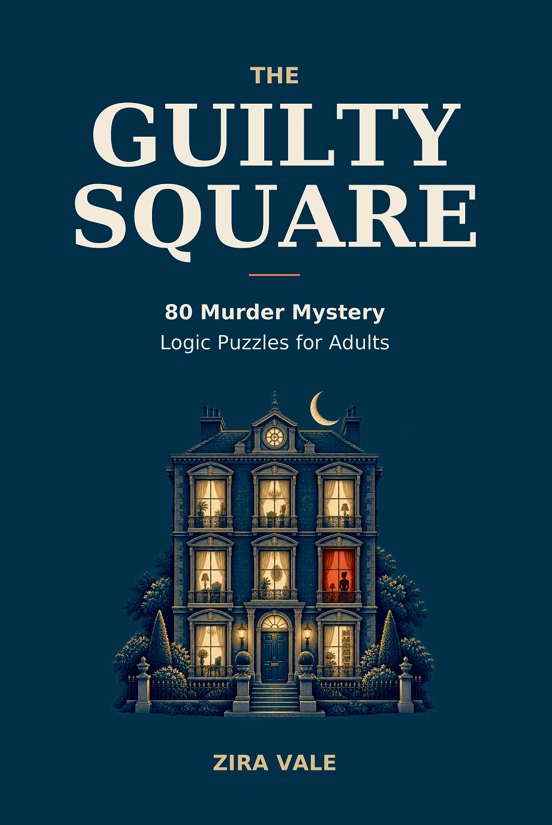
One false alibi. One guilty square. In The Guilty Square: 80 Murder Mystery Logic Puzzles for Adults by Zira Vale, every case challenges you to read the evidence, place the suspects on a room grid, test their alibis, and identify the one person whose statement cannot be true. If you enjoy murder mystery puzzles, logic grid challenges, and solving a case with pencil-and-paper deduction, this book offers a structured way to put your reasoning to work.
Ready to Solve the Case?
Get The Guilty Square: 80 Murder Mystery Logic Puzzles for Adults by Zira Vale.
If the button does not display, click here to view the Amazon listing.
This is not a collection that asks you to guess what a fictional detective might do or rely on specialist forensic knowledge. Each puzzle gives you a closed set of facts. The challenge is to make those facts fit together—and to reject any arrangement that contradicts the evidence.
Want to check out the book first? View The Guilty Square on Amazon.
What Is The Guilty Square?
The Guilty Square is a murder mystery logic puzzle book built around a simple premise: a victim occupies a marked room, suspects must be placed in the available rooms, and their statements have to be tested against verified evidence. Exactly one suspect gives a false alibi. That person is the killer, and the killer must occupy a room that shares an edge with the victim’s room.
That last condition matters. It is not enough to find a statement that sounds suspicious. You must solve the full arrangement and confirm that the guilty suspect is positioned correctly. A conclusion is only valid when the room placements, evidence clues, alibis, and victim location all agree.
The book contains 80 independent cases. Each has its own setting, victim, suspects, room map, evidence, and alibis. You can work through the cases in order or choose a case that fits your mood. There is no long storyline to memorize between puzzles, and you do not need outside knowledge to solve the cases—the relevant facts are provided on the page.


How the Murder Mystery Logic Puzzles Work
Every case asks you to reconstruct one recorded moment. A room grid shows the scene, some rooms may be sealed, and the victim’s room is marked. Each available room holds one suspect. The evidence clues are true, while exactly one suspect’s alibi is false. Your job is to find a complete placement that satisfies the rules and identifies the liar.
1. Read the room map before the statements
Start by looking at the layout. Room numbers run from left to right across each row. The victim remains in the room marked V, and sealed rooms cannot be used. Every open room must hold exactly one suspect. These restrictions give you the boundaries of the problem before you begin testing individual claims.
2. Separate verified evidence from alibis
The verified evidence is always true. An alibi is a statement made by a suspect, and one—and only one—of those statements is false. That distinction is the engine of the puzzle. Instead of deciding who seems guilty based on a story, you can test a possible liar and follow the logical consequences of that assumption.
3. Use spatial clues carefully
Some clues compare rows or columns. Others describe a person as north, south, east, or west of another suspect, or specify a grid distance. The book defines the vocabulary used in its maps, including the difference between sharing an edge and touching diagonally. A diagonal corner does not count as an edge, so precision matters when you check the final position.
4. Test one possible liar at a time
You can temporarily assume that a particular suspect is the liar. That suspect’s alibi must be false, while every other alibi must be true. Follow the consequences of the assumption. If two suspects need the same room, a clue cannot be satisfied, or the assumed killer cannot be next to the victim, the trial fails. Cross that suspect off and test another possibility.
5. Finish the whole arrangement
Do not stop as soon as one person looks suspicious. A complete solution must place every suspect, respect all room restrictions, satisfy every verified clue, and leave exactly one false alibi. The final adjacency rule must also hold. The satisfaction comes from seeing the entire map lock into place—not from guessing a name.
Ready to investigate?
Start Solving The Guilty Square →
Check the Amazon listing for current details.
80 Cases Across Five Parts
The 80 cases are organized into five parts, each containing 16 cases. The structure gives you a clear route through the book and gradually changes the kinds of relationships you need to track.
- Part 1: First Impressions (Cases 01–16). Begin with six suspects, clear landmarks, and the core rule of one false account.
- Part 2: Crossed Stories (Cases 17–32). Six suspects give accounts that connect one person to another, making it important to follow relationships across the grid.
- Part 3: Narrow Escapes (Cases 33–48). Seven suspects create tighter room restrictions and more possible arrangements to test.
- Part 4: False Fronts (Cases 49–64). Seven suspects bring overlapping spatial clues that need to be considered together.
- Part 5: Final Revelations (Cases 65–80). Eight suspects fill the scene, so every placement and relationship matters.
This progression can help you build a repeatable solving method. Early cases let you get comfortable with the rules; later cases ask you to track more suspects and connect more constraints. You can still revisit an earlier case whenever you want a shorter warm-up or a refresher on the system.

Why the Room Grid Makes Each Case Different
A room grid turns an abstract logic problem into a visual deduction exercise. Rather than keeping every relationship in your head, you can refer to a fixed map while you compare the statements. A suspect’s location affects the possibilities for other suspects, and a single confirmed placement can rule out several alternatives.
The room layout also gives the mystery a concrete finish line. The killer must share a full edge with the victim’s room. That condition narrows the possible final positions, but it does not replace the rest of the reasoning. You still need to determine which alibi is false and make sure all other suspects can be placed consistently.
For anyone searching for murder mystery logic puzzles for adults, this combination is a useful distinction: the task is not simply to read a short mystery and choose a culprit. It is a logic-grid deduction challenge with explicit rules, spatial relationships, and a solution you can verify.


Hints and Explained Solutions When You Need Help
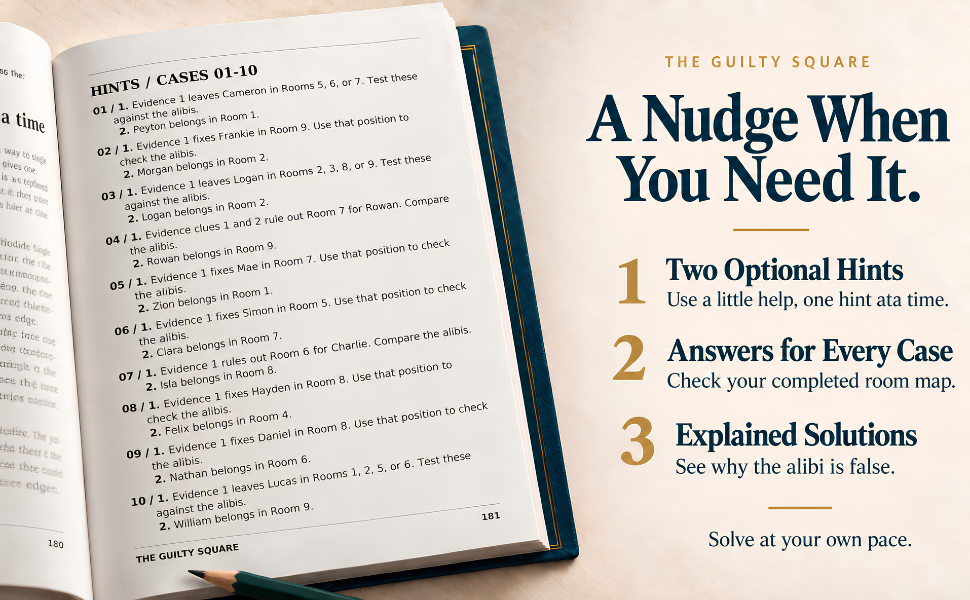
A difficult puzzle should make you think, not force you to abandon the case. The Guilty Square includes two hints for each case, followed by the full solutions in a separate section. The hints are designed to be used in stages, so you can request a small nudge before looking at a stronger clue.
Hint 1 points toward a useful deduction or a productive way to begin. Try working from that direction before reading further. If the map still refuses to settle, Hint 2 supplies a confirmed placement for an innocent suspect. Because that placement is stronger help, you can cover it or skip it until you genuinely need it.
The solutions section lets you check your completed map and understand the logic behind the answer. Instead of treating a wrong attempt as failure, compare it with the confirmed arrangement and look for the first point where a clue or alibi stopped fitting. That review can help you recognize the same kind of contradiction in a later case.

Ready to investigate?
View the Book and Its Puzzle Features →
Check the Amazon listing for current details.
A Practical Solving Routine for Beginners
You do not need to be an expert in logic puzzles to begin. A consistent routine makes the rules easier to manage and helps prevent small placement errors from spreading across the grid.
- Mark the fixed facts. Keep the victim in the V room and cross out sealed rooms. Do not allow a suspect to occupy either.
- Write down the available rooms. Check how many suspects and open rooms remain. Each open room has one occupant, so duplicate placements are not allowed.
- Record the evidence first. Use the verified clues to narrow the possible positions before you commit to a suspect’s claim.
- Choose a candidate liar. Temporarily treat one alibi as false. Check whether every other alibi can remain true under that assumption.
- Follow the chain of consequences. A same-column clue, a row restriction, or a grid-distance clue may force another placement. Recheck the full map whenever something becomes fixed.
- Reject contradictions early. If two people need the same room or a confirmed clue cannot be true, discard the trial rather than trying to force it.
- Check the killer’s position. The one false alibi identifies the killer, but the killer must also share an edge with the victim’s room.
- Verify the complete answer. Re-read every clue and every alibi against the finished arrangement before checking the solutions.
A pencil is useful because a trial placement is temporary. Mark possibilities lightly, cross out rejected options, and keep your notes close to the map. The book also provides deduction-note space beneath the alibis, giving you a place to record a useful placement or a possible contradiction.

What Makes This a Good Screen-Free Puzzle Activity?
Logic puzzles offer a structured activity you can return to for a few minutes or a longer solving session. Each case gives you a clear objective and a finite set of facts to work through. You can pause, come back later, and pick up from the notes you made. There is no need to keep a score or race a timer; the goal is to reach a consistent solution.
The murder-mystery theme adds a reason to care about the answer, while the room grid keeps the work grounded in logic. If you like deduction games, classic whodunit stories, brain teasers, or pencil-and-paper activities, this format brings several familiar pleasures together. It can also be an enjoyable way to take a break from screens without needing a board, cards, or an app.
It is best approached as a focused puzzle activity rather than as a book of conventional short stories. The case descriptions establish a setting and a reason to investigate, but the main experience is solving the grid, testing the alibis, and identifying the only arrangement that satisfies the rules.
Who Might Enjoy The Guilty Square?
- Logic-puzzle fans: especially readers who like constraints, deduction, and checking a solution step by step.
- Murder-mystery readers: people who enjoy the question “who did it?” and want to work out the answer themselves.
- Logic-grid puzzle solvers: readers who like tracking rows, columns, room positions, and relationships between clues.
- Adults who enjoy brain teasers: anyone looking for a paper-based challenge that rewards careful reasoning.
- Gift shoppers: people choosing a puzzle book for a friend or family member who enjoys mystery themes and solving problems.
- Casual and regular puzzlers: the five-part structure makes it possible to progress through the cases or return to a puzzle when you have time.
Because the book explains its vocabulary and rules at the beginning, you can learn the system before taking on the cases. You do not need to know forensic science, solve a hidden code, or remember details from previous stories. The evidence needed for each puzzle is printed with that case.
Inside the Book: What to Expect
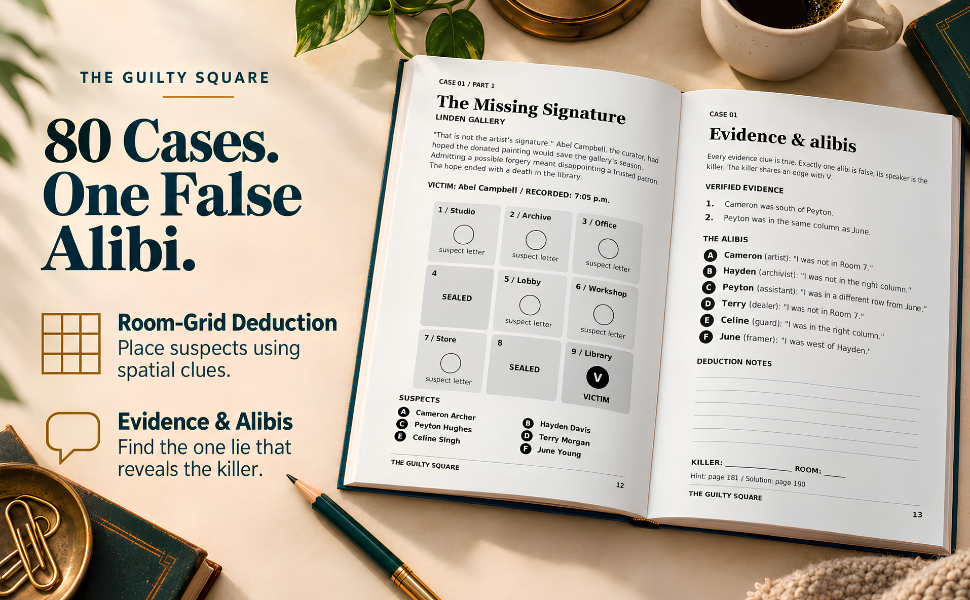
Each case opens with its map on one side and the evidence on the other. The case page identifies the victim and the recorded time, shows the room layout, lists the suspects, and presents verified evidence separately from the alibis. A space for deduction notes lets you track your reasoning, and the case points to the relevant hint and solution pages.
The back matter is designed to support independent solving. Hints are grouped by case number, and the solutions begin later in the book so that you can avoid seeing an answer too early. If you prefer to solve without help, leave those pages untouched until you need them. If you get stuck, use the first hint, return to the map, and only move to the next level when necessary.

Tips for Getting More from Each Puzzle
Do not guess from personality. A character description may set the scene, but the solution comes from the facts. Treat every suspect’s statement as a claim to be tested.
Keep evidence and alibis separate. Verified evidence is true. The one false alibi is the exception. Keeping that difference visible helps you avoid accidentally rejecting a clue that must hold.
Pay attention to the wording. “Different row,” “same column,” “west of,” “exactly two grid steps,” and “shares an edge” express different relationships. Use the book’s definitions rather than assuming two terms mean the same thing.
Recheck earlier deductions. A new placement may reveal that an earlier assumption cannot work. When that happens, retrace the chain instead of changing a confirmed clue to make the map fit.
Use the hints without guilt. The hints are there to help you continue. Taking a nudge does not remove the reasoning challenge; you still have to connect the information and finish the case.
Confirm every statement at the end. A convincing-looking map is not complete until all suspects are placed, all verified evidence fits, exactly one alibi is false, and the killer is next to the victim by a shared edge.
Is The Guilty Square Worth Looking At?
If your ideal puzzle book combines a clear rule system with the atmosphere of a murder investigation, The Guilty Square: 80 Murder Mystery Logic Puzzles for Adults is built around that experience. It offers 80 standalone cases, a room-grid format, five organized parts, two optional hints per case, and explained solutions for checking your reasoning. The central task stays consistent, while the number of suspects and the spatial relationships become more demanding as you progress.
It is particularly suited to readers who prefer to work out an answer rather than simply read one. You can use the book for a short puzzle break, a longer session with several cases, or a screen-free activity at your own pace. If you enjoy logic grid puzzles, murder mystery brain teasers, and deduction challenges for adults, take a look at the listing and decide whether the format suits you.
Ready to investigate?
Check The Guilty Square on Amazon →
Check the Amazon listing for current details.
Book: The Guilty Square: 80 Murder Mystery Logic Puzzles for Adults
Author: Zira Vale
Format: Paper-based murder mystery logic puzzles
Inside: 80 cases, room-grid deduction, verified evidence, suspect alibis, two hints per case, and explained solutions.
Visit the Amazon product page for The Guilty Square. Current price, format details, and availability are shown on Amazon and may change.
Ready to Open Your Next Case?
Bring The Guilty Square to your puzzle time and test your deduction skills.
See The Guilty Square on Amazon →
Frequently Asked Questions
How many puzzles are in The Guilty Square?
The book contains 80 independent murder mystery logic puzzles organized into five parts of 16 cases each.
Is this a traditional murder mystery story?
It is primarily a puzzle book. Each case provides a short setting, a room map, suspects, verified evidence, and alibis. You solve the arrangement and identify the one suspect whose alibi is false.
Do I need experience with logic-grid puzzles?
No specialist knowledge is required. The book explains its rules and spatial vocabulary before the cases begin. You can learn the system as you work through the puzzles.
Are hints and answers included?
Yes. Each case has two hints, and the book includes a separate solutions section. The first hint offers a way to begin; the second provides a stronger nudge with a confirmed placement.
What makes the killer different from the other suspects?
Exactly one suspect gives a false alibi, and that suspect is the killer. The killer must also occupy a room that shares a full edge with the victim’s room. Diagonal contact does not count as sharing an edge.
Can I solve the puzzles in any order?
The cases are independent, so you can work through them in order or choose a case that suits your mood. Following the five parts in sequence is one way to experience the changing suspect counts and spatial relationships.
Where can I find The Guilty Square?
You can view the book on Amazon here: The Guilty Square by Zira Vale. Check the listing for current product details and availability.
Ready to investigate?
View The Guilty Square on Amazon →
Check the Amazon listing for current details.
Frequently Asked Questions
How many puzzles are in The Guilty Square?
The book contains 80 independent murder mystery logic puzzles organized into five parts of 16 cases each.
Is this a traditional murder mystery story?
It is primarily a puzzle book with a short case setting, room map, suspects, verified evidence, and alibis to solve.
Do I need experience with logic-grid puzzles?
No specialist knowledge is required. The book explains its rules and spatial vocabulary before the cases begin.
Are hints and answers included?
Yes. Each case has two hints, and a separate solutions section helps readers check their reasoning.
What makes the killer different from the other suspects?
Exactly one suspect gives a false alibi, and that suspect must occupy a room sharing a full edge with the victim's room.
Where can I find The Guilty Square?
You can view The Guilty Square by Zira Vale on Amazon: https://www.amazon.com/dp/B0HLTWKJ1K


0 Comments