
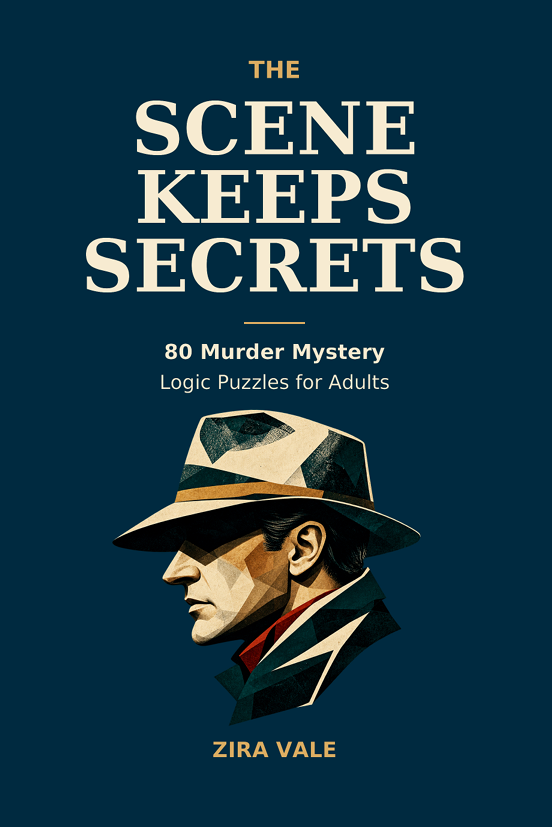
Some mysteries are meant to be read. Others invite you to take the case into your own hands. The Scene Keeps Secrets: 80 Murder Mystery Logic Puzzles for Adults by Zira Vale is designed for readers who enjoy following evidence, testing alibis, mapping a scene, and working out which conclusion fits every clue. Instead of simply turning pages to learn what a detective discovers, you become the investigator.
If you enjoy detective puzzles, whodunit challenges, logic-grid puzzles, and brain teasers that reward careful reasoning, this book offers a screen-free way to put those skills to work. Each fictional case gives you a structured problem to investigate. Read the rules, study the plan or grid, connect the clues, and identify the killer without relying on a lucky guess.
Ready to open the case? Get The Scene Keeps Secrets on Amazon.
What Is The Scene Keeps Secrets?
The Scene Keeps Secrets is a murder mystery logic puzzle book for adults featuring 80 fictional cases. Each case asks you to use the information printed on the page to reconstruct what happened and determine who is responsible. The book combines mystery storytelling with structured deduction tools, including scene plans, route diagrams, timelines, and logic grids.
The key idea is simple: the answer must follow from the evidence. The stories create atmosphere and give each investigation a setting, but the solution comes from applying the stated facts and clues carefully. You are not expected to know specialist details about crime, medicine, engineering, or geography. The book explains how to read its plans and notation, and the puzzles are designed to be solved from the information provided.
That makes this a different experience from a traditional mystery novel. In a novel, you follow the protagonist's investigation. Here, you are responsible for testing the evidence yourself. You can pause, write on the pages, mark exclusions, revisit a clue, and check the explanation after you have made your own deduction.
Inside the Book: 80 Cases Across Different Deduction Styles
The book is organized into five parts, with the cases progressing through a range of settings and reasoning approaches. The variety matters: not every mystery is solved by matching a suspect to an object. Some cases depend on a room layout, some on movement and timing, and others on a traditional deduction grid.
- Part 1 — Open Doors: The opening investigations introduce the book's approach to scene plans, positions, objects, timing, and clue-based reasoning.
- Part 2 — Changing Views: The cases continue to vary the way information is presented, asking you to interpret details and test relationships instead of relying on one repeated puzzle template.
- Part 3 — Crossed Paths: More investigations build on positional relationships, routes, patterns, and interconnected deductions.
- Part 4 — Final Accounts: The later cases continue the mix of scene-based and grid-based reasoning, asking you to keep track of more relationships.
- Part 5 — The final stretch: The book moves toward its final cases, giving readers a longer progression through the full set of 80 mysteries.
The structure makes the book suitable for a one-case break or a longer detective-puzzle session. You can solve a single case with a pencil and return to the next one later, or work through several when you have time to focus.
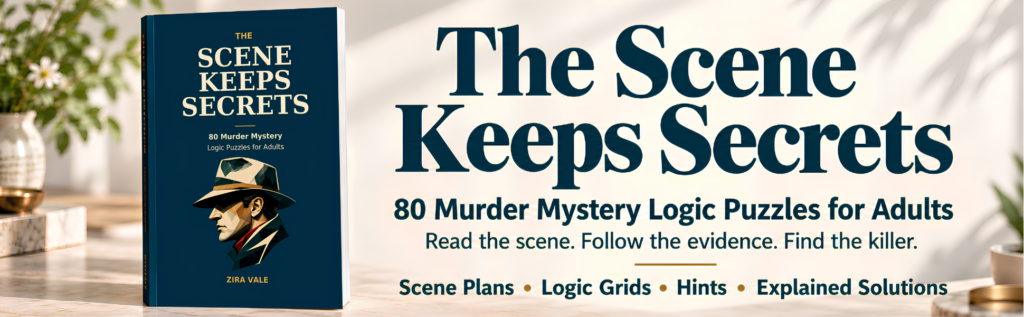
The book’s promotional scene-plan preview highlights the mix of case files, visual layouts, and evidence-led solving.
Scene Plans: Read the Room Like a Detective
One of the distinctive features of The Scene Keeps Secrets is its use of visual scene plans. Rather than relying only on a paragraph describing where everyone was, some cases give you a labeled floor plan, room arrangement, route diagram, or positional layout. You use the labels and rules printed with the case to work out where each person could have been.
That means details such as a locked door, an open hatch, a blocked passage, a one-way link, or the position of a room can become important. A suspect may sound suspicious in the story, but suspicion alone is not enough. You need to test whether the stated route or position actually fits the established evidence.
The book explains its notation before the investigations begin. For example, north is generally up unless a case says otherwise; a row is horizontal and a column is vertical; labeled links show the connections that can be used; and a blocked opening cannot simply be ignored. Plans are schematic rather than measured maps, so the printed labels and case-specific rules matter more than estimating distances from the drawing.
These visual deduction puzzles are especially appealing to readers who enjoy spatial reasoning. You are not just reading clues—you are translating them into a layout, checking what is possible, and ruling out what cannot work.
Logic Grids: Turn Clues Into Clear Deductions
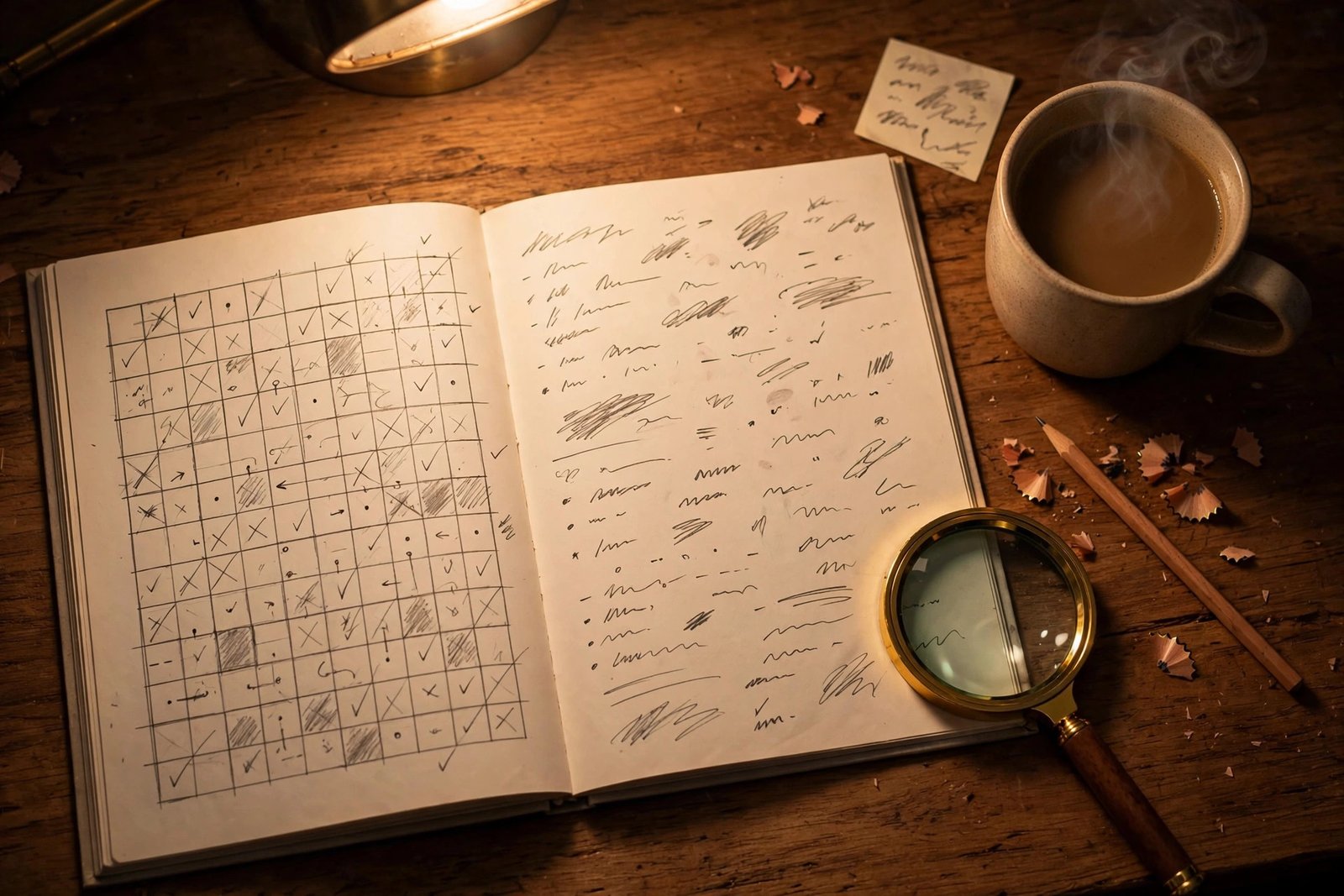
Other cases use deduction grids to help you match people with objects, locations, times, or other categories. A grid provides a place to record what you know and what you can eliminate. A tick marks a confirmed match; an X rules out a pairing. Each row and column is used according to the case's rules.
For example, a case might ask you to connect a group of visitors with different objects and work areas. A clue could establish that one object was at a particular station, while another clue rules out a suspect from a location. Each deduction narrows the remaining possibilities. When you carry those deductions across the related grids, the complete assignment becomes clearer.
The most useful habit is to record exclusions as carefully as confirmed matches. If a clue says a person was not in a certain room, mark that information rather than keeping it only in your memory. One exclusion can create a forced match elsewhere. The goal is not to guess what seems likely; it is to find the assignment that satisfies the entire set of rules.
The book includes 20 deduction-grid cases alongside its scene and map-based cases. This mixture gives readers more than one way to investigate and helps keep the solving experience varied.

This preview presents the book as a hands-on investigation: study the case, follow the evidence, and work toward a logical conclusion.
How to Solve a Case Without Guessing
You do not need to be an experienced puzzle solver to begin. A steady method is more useful than trying to spot the answer immediately. Use this process whenever you open a new case.
1. Read the rules before the story clues
Start with the case's established evidence and rules. They define what must be true, how the diagram works, and whether special conditions apply. A statement in a quoted report may be treated differently if the case explicitly tells you that only a certain number of statements are true. Follow the printed rule instead of assuming every sentence has the same status.
2. Separate atmosphere from evidence
A keepsake, an argument, a strange gesture, or a character's background may help create the scene. It does not automatically prove guilt. Use the numbered clues, established facts, plan labels, and any relevant rule. Avoid inventing an accomplice, an exchange of objects, or a route that the puzzle's rules exclude.
3. Make a complete assignment
When a case asks you to place people, objects, or times, use every listed item exactly as directed. Do not assign the same room to two people if the rules require one person per room. In a grid puzzle, copy each deduction into the other comparisons where it applies.
4. Test the fatal action
Once the placements are consistent, check the evidence that connects a suspect to the murder. Could the person reach the victim? Did the route work within the stated time? Was the relevant object in that person's possession? Does the scene plan allow the line of sight or access described? Being nearby is not enough if the required action could not have happened.
5. Use a hint if you get stuck
Each solution includes two optional hints, the complete assignment, and an explanation. Try to make as much progress as you can before looking. A hint can help you restart your reasoning without immediately giving away the whole answer.
6. Check the explanation after solving
When you have identified a suspect, compare your reasoning with the solution. The explanation helps you see which deductions were decisive and whether you overlooked an exclusion. If your answer differs, retrace the chain rather than changing a mark at random.
This approach makes a murder mystery logic puzzle feel fair: the conclusion should emerge from the clues, and the explanation should show how the pieces fit together.
Hints and Explained Solutions: Help When You Need It
A challenging puzzle is more satisfying when you can work through it independently, but getting stuck on one clue can interrupt the fun. The book's optional hints give you a way to keep moving without immediately jumping to the final answer. You can choose to solve unaided, ask for a small nudge, or consult the full explanation when you are ready.
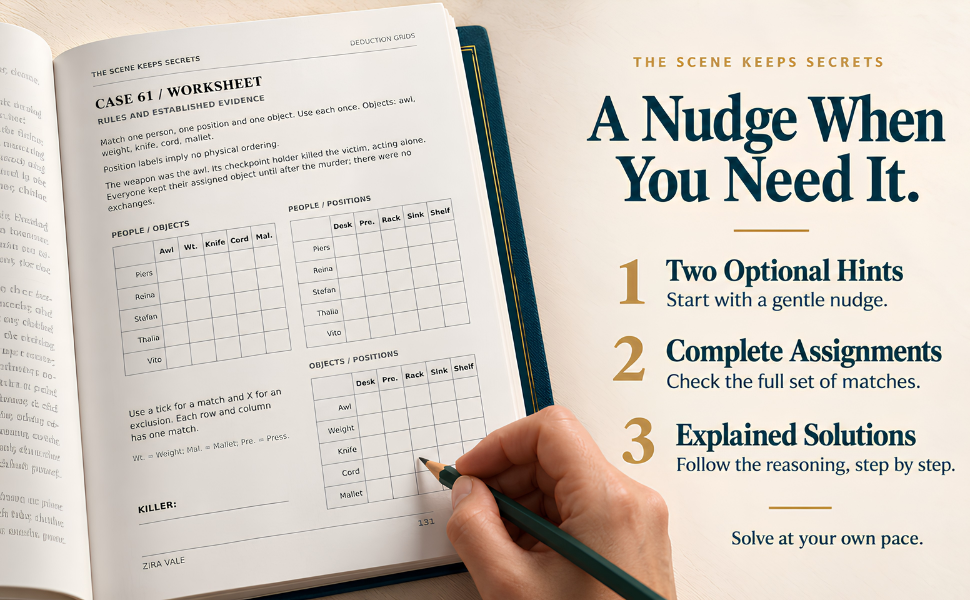
The solutions section begins later in the book, after the case pages. Each solution provides two hints, the complete assignment, and a step-by-step explanation. That structure is useful for readers who want to learn a solving method as they go, not simply check whether they named the right suspect.

The hints-and-solutions preview shows how the book supports independent solving while providing a way to check the reasoning.
Who Will Enjoy This Murder Mystery Puzzle Book?
The Scene Keeps Secrets may be a good fit if you enjoy one or more of the following:
- Murder mystery puzzles for adults: You like identifying the culprit by evaluating evidence instead of reading a mystery passively.
- Logic grid puzzles: You enjoy making matches, marking exclusions, and narrowing a set of possibilities until only one assignment remains.
- Detective brain teasers: You like timelines, suspect lists, room layouts, routes, and questions that reward attention to detail.
- Spatial reasoning challenges: You enjoy interpreting plans and working out which locations or paths are possible.
- Screen-free activities: You want a paper-based activity for a quiet evening, a trip, a weekend, or a break from devices.
- Thoughtful gifts for puzzle fans: You are looking for a gift for someone who enjoys whodunit mysteries, deductive challenges, and brain games.
It can also suit readers who want a structured activity they can return to in short sessions. You do not have to finish the whole book in one sitting. One case at a time gives you a clear goal and a satisfying stopping point.
A Different Kind of Brain Teaser
Many brain teasers depend on a quick trick or an unexpected interpretation. The cases in this book emphasize careful deduction: use the stated information, eliminate impossible options, and see which answer remains. That can make the experience feel closer to working a case file than answering a riddle.
Because the book mixes visual scene plans with grid-based puzzles, you can switch between different kinds of reasoning. One case may ask you to follow a route or compare timing; another may ask you to match people, places, and objects. The common thread is disciplined attention to evidence.
There is no need to know the technical details of real investigations. The book says its fictional puzzles do not require outside knowledge of crime, medicine, engineering, or local geography. The information needed for each case is supplied in the puzzle itself.
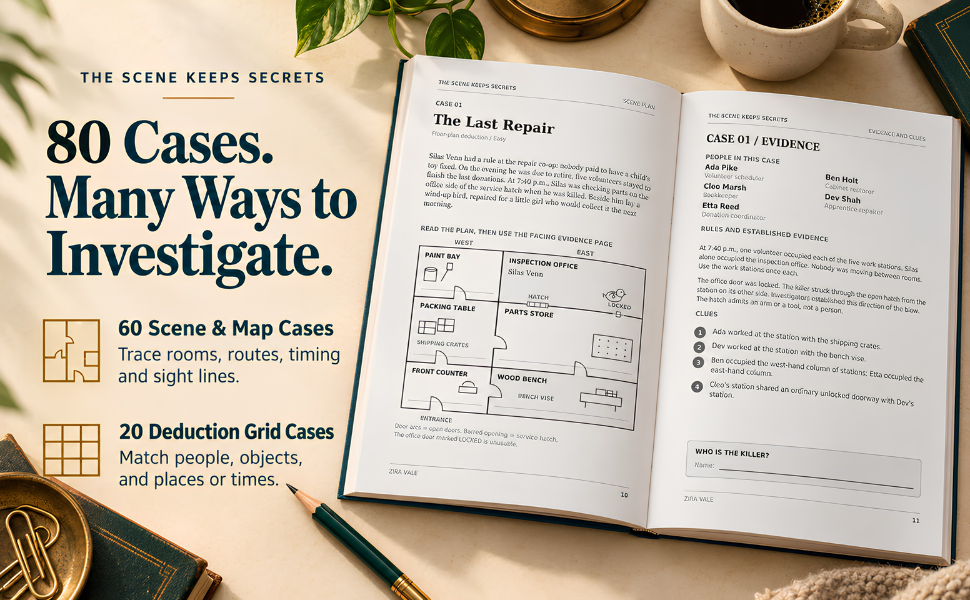
The book’s interior preview illustrates the hands-on format: printed clues and grids designed to be studied and marked as you solve.
Why the Scene-Plan Format Stands Out
In a conventional logic grid, you may spend most of your time comparing names and categories. Scene-plan puzzles add another layer: the spatial arrangement can matter. A door may connect two rooms, a station may sit in a particular row, a route may have a minimum travel time, or a sightline may be blocked. Those details create a mystery that you can reconstruct visually.
The important point is that the diagram is not a decoration. It is part of the evidence system. Learn how the labels work, follow any arrows or marked links, and pay attention to the special definitions in each case. If the puzzle defines “directly above,” “immediately left,” or “next listed time,” use that definition exactly rather than relying on everyday assumptions.
This makes the book especially interesting for people who like deduction puzzles that combine reading comprehension, organization, and spatial logic. It also offers a useful reminder: the best answer is not always the most dramatic suspect. It is the answer that satisfies every established fact.
Get The Scene Keeps Secrets on Amazon
If you are ready to take on 80 murder mystery logic puzzles, you can view the book on Amazon. Check the product page for the current price, availability, format, and other listing details before ordering.
View The Scene Keeps Secrets on Amazon →

Use the linked Amazon button above to visit the product listing for The Scene Keeps Secrets by Zira Vale.
If you prefer to open the listing directly, use this link: The Scene Keeps Secrets: 80 Murder Mystery Logic Puzzles for Adults on Amazon.
Frequently Asked Questions
How many puzzles are in The Scene Keeps Secrets?
The book contains 80 fictional murder mystery logic puzzles for adults. The cases use a mix of scene plans, route and timeline deductions, and logic-grid assignments.
Does the book include hints and answers?
Yes. Each solution includes two optional hints, the complete assignment, and an explanation so you can check your reasoning after trying the case.
Do I need to know about real crime investigations?
No. The book explains its notation and states that its puzzles can be solved using the information provided, without outside knowledge of crime, medicine, engineering, or local geography.
Are all the puzzles traditional logic grids?
No. The book includes scene-plan and map-based investigations as well as 20 deduction-grid cases. The different formats ask you to reason about locations, routes, objects, people, and timing in different ways.
Can I solve the puzzles one at a time?
Yes. The cases can be approached individually, so you can solve one during a short break or work through several when you have more time.
Where can I buy The Scene Keeps Secrets?
You can visit the Amazon product page here: The Scene Keeps Secrets by Zira Vale on Amazon. Check the listing for current availability and pricing.
Open the Case. Follow the Evidence. Find the Killer.
The Scene Keeps Secrets: 80 Murder Mystery Logic Puzzles for Adults offers a hands-on way to enjoy detective puzzles, logic-grid challenges, and evidence-led problem solving. With 80 fictional cases, visual scene plans, varied deduction formats, optional hints, and explained solutions, it gives you a reason to slow down, examine the details, and work toward a conclusion that fits.
Grab a pencil, read the rules, and let the evidence lead the way. Find the book on Amazon.
Frequently Asked Questions
How many puzzles are in The Scene Keeps Secrets?
The book contains 80 fictional murder mystery logic puzzles for adults, including scene-plan, route and timeline deductions, and logic-grid cases.
Does The Scene Keeps Secrets include hints and answers?
Yes. Each solution includes two optional hints, the complete assignment, and an explanation.
Do I need knowledge of real crime investigations?
No. The puzzles are designed to be solved using the rules and evidence printed in the book, without outside specialist knowledge.
Are all the puzzles traditional logic grids?
No. The book mixes scene-plan and map-based cases with 20 deduction-grid cases.
Can I solve the puzzles one at a time?
Yes. The cases can be completed individually in short sessions or as part of a longer puzzle session.
Where can I buy The Scene Keeps Secrets?
Visit the Amazon product page at https://www.amazon.com/dp/B0HLWPYQ52 and check current availability and pricing.


0 Comments